



The Core Idea: Agents as Economic Actors
Coinbase is making a very specific bet — that AI agents won’t just assist with financial decisions, they’ll make them.
Through Coinbase for Agents, users can instruct their agent in plain language: rebalance my portfolio, find a trading opportunity, hold this position. The agent executes. No dashboard required, no manual confirmation loop.
Lincoln Murr, Coinbase’s AI product lead, framed it bluntly: “The whole idea is to give agents access to money and, through that financial independence, improve their set of capabilities to pretty much anything on the internet.”
That’s not a product pitch. That’s a thesis about what the internet becomes next.
Meet x402: The Protocol That Lets Agents Pay for Things

The more quietly radical piece of this launch is x402 — Coinbase’s machine-to-machine payments protocol.
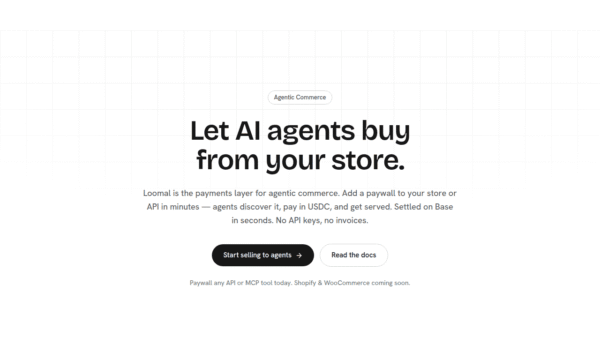
x402 lets agents pay directly for paywalled research, data APIs, and on-demand compute without a human in the loop. No login. No subscription management. No credit card form. The agent identifies what it needs, pays for it in USDC, and acts on the result.
Coinbase introduced x402 in May 2025. Since then, it has processed over 100 million transactions, with roughly 157,000 agents acting as buyers in the past 30 days alone. That’s not a pilot. That’s traction.
Why This Is Bigger Than Crypto Trading
The trading angle gets the headlines. But the payments layer is where the real ecosystem shift lives.
Coinbase describes agentic payments as a precursor to agentic shopping — where agents browse, compare, select, and purchase on your behalf. Think of it as the autonomous layer sitting between your intent and the internet’s commerce infrastructure.
The login-and-subscription model that has defined digital services for two decades starts to look fragile here. If agents can pay per-use, in real time, in stablecoins, the entire subscription economy faces a quiet renegotiation.
The Business Model Is Already Working

Coinbase isn’t doing this out of idealism. The unit economics are clear.
Every agent-executed trade generates trading fees. Every USDC movement through x402 captures fees and spreads. Every transaction runs on Base, Coinbase’s in-house Layer 2 blockchain — increasing volume on infrastructure Coinbase already owns.
The more agents transact, the more Coinbase earns. It’s a flywheel built on the assumption that agentic activity will compound fast.
The Timing Is Deliberate (and a Little Contrarian)
This launch lands at an interesting intersection. Agentic AI is the hottest investing theme of the moment. Crypto, meanwhile, is in a relatively quiet post-cycle phase.
Coinbase is threading both needles — riding the AI wave while pushing deeper into crypto infrastructure during a softer trading environment. It’s a hype-aligned move that also happens to be a long-term infrastructure play.
Murr drew the analogy directly: “In the 2010s, every internet company dealt with the transition from desktop and web into mobile. Now in the late 2020s, agents are going to be the new primary economic actors on the internet.”
The companies that built mobile-first in 2012 didn’t look prescient until 2015. The pattern is familiar.
What This Means for the AI Tools Ecosystem
For anyone tracking AI tools and workflows, this is a category-defining moment worth watching closely.
Financial automation is graduating from “AI helps you analyze” to “AI acts on your behalf.” That changes the risk profile, the trust requirements, and the tooling stack around every AI workflow that touches money.
Builders integrating AI agents into products now have a payments primitive to work with. Founders building on top of agentic systems need to think about what it means when their users’ agents can spend autonomously.
And for everyday adopters — the people who just want their tools to work — the promise is simpler: less friction between your intent and the outcome.
The Takeaway
Coinbase for Agents and the x402 protocol aren’t just new features. They’re an early blueprint for what agentic finance looks like at scale — autonomous, composable, and running on stablecoins.
The question isn’t whether AI agents will become financial actors. Based on 100 million x402 transactions, they already are.
The real question is: how fast does the rest of the internet catch up?















Comments (0) No comments yet
Want to join this discussion? Login or Register.
No comments yet. Be the first to share your thoughts!