


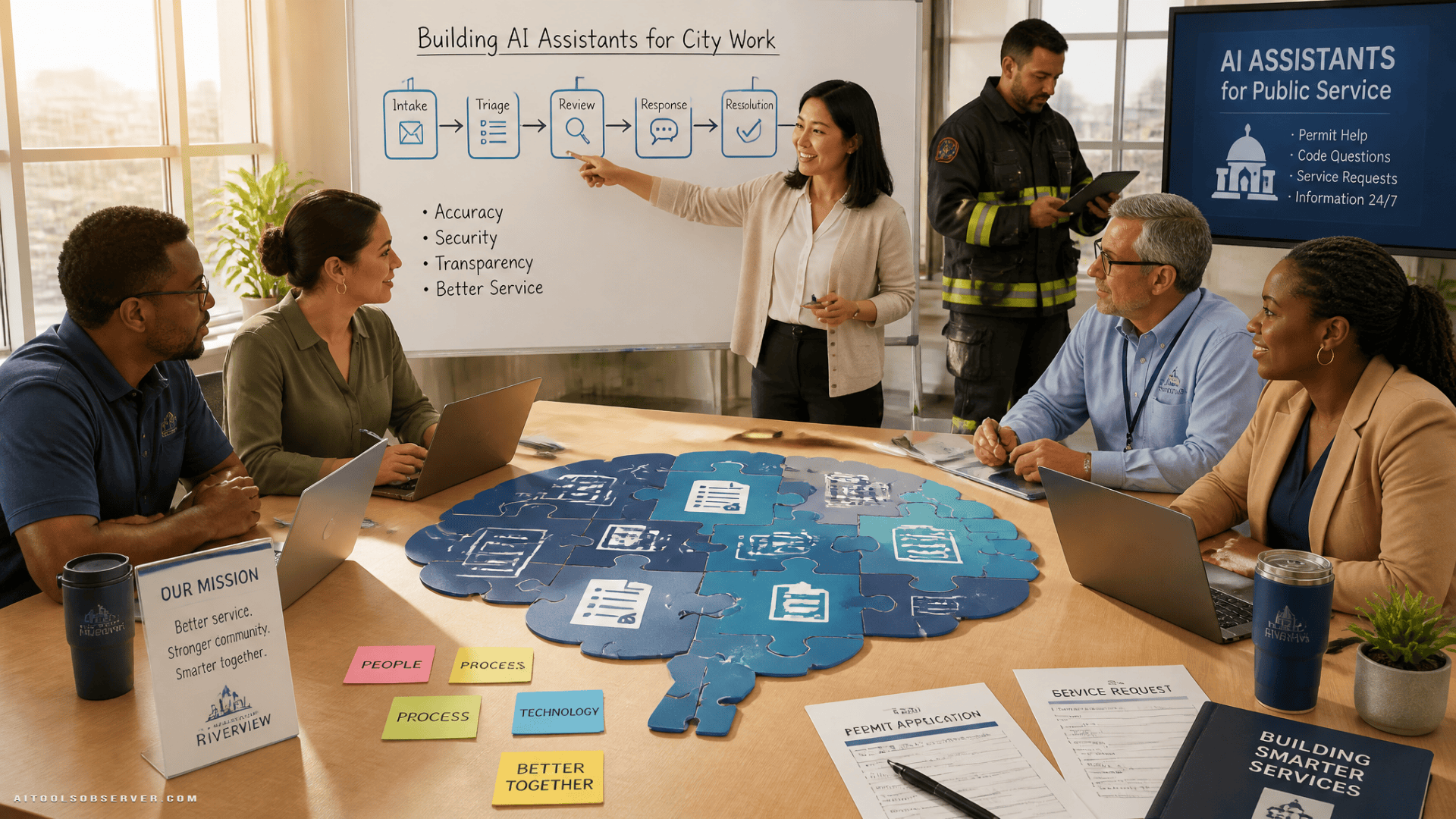
The Core Problem San Jose Was Solving
City employees were drowning in repetitive, document-heavy work. Reviewing contractor proposals, drafting project charters, checking fire truck equipment before deployment — these tasks consumed hours that could be spent on higher-value work.
The challenge wasn’t just time. It was also skill. Most employees had little to no experience with AI, and even those who had experimented with it lacked the ability to engineer prompts, build assistants, or structure data for reliable outputs.
San Jose needed a way to close that gap at scale, across departments with very different workflows.
What the Program Actually Looks Like
The AI Upskilling Program is a 10-week, city-led training initiative developed in partnership with San Jose State University. It’s structured enough to take employees from zero to building functional AI tools, but practical enough to stay grounded in real job tasks.
The program has since been shared with the GovAI Coalition so other municipalities can use it as a blueprint — which signals that San Jose isn’t treating this as a competitive advantage but as a model worth replicating.
Key things the program teaches:
- How to train an AI model with specific examples and target outcomes
- How to structure prompts for consistent, reliable results
- How to define tone, format, and output expectations
- How to apply AI to actual daily workflows, not hypothetical use cases
Real Tools Built by Real City Employees
The most compelling part of this story isn’t the program itself — it’s what employees built with it.
Project Charter Assistant (IT Department)
Paulina Hen, a project manager on the IT team, built an AI assistant to help draft project charters, summarize meeting notes, and review documents. Before the program, her perspective on AI was shaped largely by her kids warning her it would get them an “F” in school.
After completing the training, she learned how to feed the AI model examples of what good output looks like — the structure, the tone, the format. The result: tasks that used to take months now take a day.
“For me, it’s definitely a lot faster in terms of getting documents out there,” she said. She’s clear that AI doesn’t replace her judgment — it just removes the friction of getting words on a page.
Landscape Inspection Assistant (Transportation Department)
Amanda Nichols, an associate construction inspector, had already been using AI for about a year before the program. But she hit a ceiling — she didn’t know how to build assistants or structure information for reliable results.
The program gave her the skills to build the Landscape Inspection Assistant, a tool that reviews contractor proposals against city requirements. Before it existed, manually reviewing proposals in Adobe took more than five hours per cycle, with multiple rounds of back-and-forth emails to correct errors.
After deploying the assistant, proposal revision time dropped from five-plus hours to one or two minor corrections. She can now often approve proposals within a single business day.
Fire Truck Equipment Verification Tool (Fire Department)
A San Jose Fire Department employee built an AI tool that verifies trucks are properly equipped before deployment. This is a safety-critical workflow where errors have real consequences — and it’s now partially automated.
Power BI Support Assistant (IT Department)
Another IT employee built an AI assistant that helps staff navigate Power BI dashboards, reducing the internal support burden for a tool that many employees use but few fully understand.
What Made This Work
A few things stand out about why San Jose’s approach appears to have delivered results where other programs stall.
It was grounded in real problems. Employees weren’t trained on abstract AI concepts — they were pushed to identify a specific daily challenge and build toward solving it. Nichols put it plainly: “The best AI solutions are not necessarily the most complex. They are the ones that solve a specific challenge and make everyday tasks easier.”
It built confidence, not just competence. Several participants described the program as giving them the confidence to experiment. That psychological shift matters — employees who feel capable are more likely to keep iterating after the training ends.
It included guardrails. Hen emphasized that employees can’t rely solely on AI output. Human oversight is built into the mindset the program instills, which is critical for government workflows where accuracy and accountability matter.
It scaled through partnership. Developing the curriculum with San Jose State University gave the program academic rigor without requiring the city to build everything internally. Sharing it through the GovAI Coalition extends its impact beyond San Jose.
The Tradeoffs Worth Noting
This program isn’t a plug-and-play solution. A 10-week commitment is significant for city employees with full workloads. Not every department will have the same capacity to participate, and the quality of tools built will vary based on individual skill and motivation.
There’s also the question of maintenance. AI assistants built by individual employees need to be updated as workflows change, city requirements evolve, or AI models are updated. It’s not clear how San Jose handles that ongoing support layer.
Security is another consideration Hen flagged directly — employees need to be conscious about what data they feed into AI models, especially in a government context where sensitive information is common.
What Other Cities and Organizations Can Take From This
San Jose’s program is now available as a blueprint through the GovAI Coalition, which means other local governments don’t have to start from scratch. That’s a meaningful shortcut.
But the broader lesson applies beyond government. The pattern that worked here — identify a real daily pain point, teach employees to build toward solving it, and maintain human oversight — is transferable to any organization trying to move from AI curiosity to AI productivity.
The employees who got the most out of this program weren’t the most technically sophisticated. They were the ones who connected the training to a specific problem they were already frustrated by.
That’s the practical takeaway: AI upskilling works best when it starts with a problem worth solving, not a tool worth learning.






Comments (0) No comments yet
Want to join this discussion? Login or Register.
No comments yet. Be the first to share your thoughts!