


The Market Is Growing Fast—and Concentrating Faster
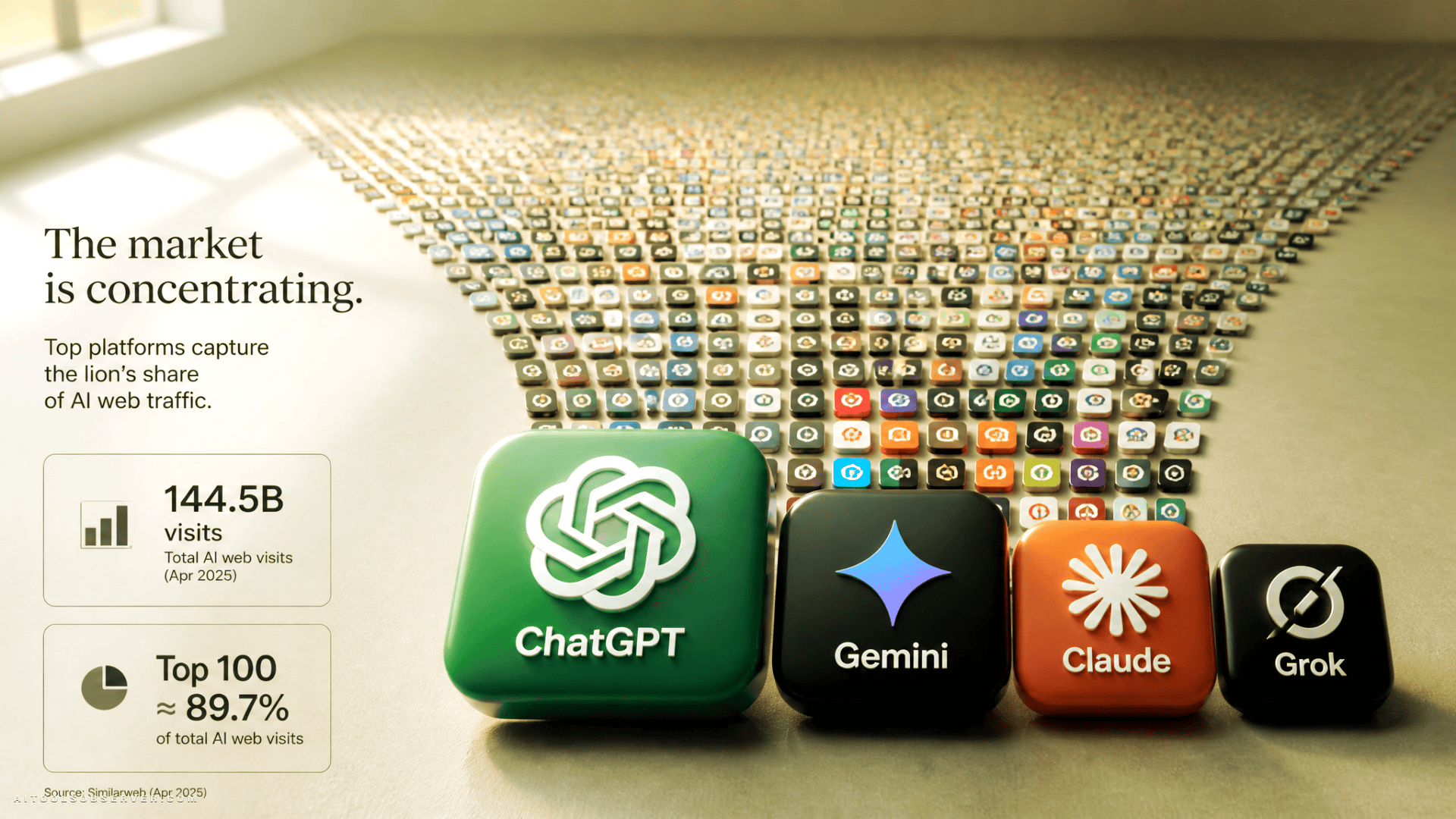
Total AI web traffic grew 40.12% year over year. That’s strong by any measure. But the distribution of that traffic is becoming increasingly lopsided.
The top 100 AI tools captured 129.6 billion of the 144.5 billion total visits. The remaining 9,431 tools split just 10.31% of the market between them.
For context: if you’re building or evaluating a specialized AI tool outside the top tier, you’re competing for a shrinking slice of attention. The platforms at the top aren’t just winning—they’re pulling further ahead.
ChatGPT’s Lead Is Staggering
ChatGPT attracted 64.7 billion visits over the past year. That’s 44.76% of the entire AI tools market, and nearly half of all traffic among the top 100 platforms.
Its closest competitor, Canva, received more than six times less traffic.
But here’s the tension worth watching: ChatGPT’s rivals are growing much faster.
- Grok: +731.26% traffic growth
- Gemini: +450.33%
- Claude: +250.07%
ChatGPT still dominates in absolute volume. The challengers are closing the gap in momentum. Whether that momentum translates into meaningful market share redistribution is the key question for the next 12–18 months.
Chatbots Are Eating Specialized Tools
This is arguably the most consequential finding in the report.
Users are abandoning purpose-built AI applications in favor of general-purpose conversational assistants. The data is direct:
- Google Translate: -1.5 billion visits (-23.46%)
- Chegg: -61.45%
- Quizlet: -29.09%
- QuillBot: -25.24%
People are using ChatGPT, Claude, or Gemini to translate text, write essays, study for exams, and paraphrase content—tasks that previously required dedicated tools.
The result: chatbot traffic jumped 90.82% year over year to 86 billion visits, giving the category a 59.52% share of the entire AI tools market. Translator tools, by contrast, lost 1.6 billion visits—a 22.52% decline.
What This Means for Tool Builders and Buyers
If you’re evaluating AI tools for a workflow, the calculus has shifted. A general-purpose assistant may now cover 70–80% of what a specialized tool once did—at lower cost and with less friction.
If you’re building a specialized tool, the pressure to differentiate on depth, accuracy, or workflow integration has never been higher. Competing on surface-level features against ChatGPT is not a viable strategy.
Geography: Singapore Leads on Intensity, the US on Volume
The United States generated the highest total AI traffic at 29.2 billion visits. But when adjusted for population, Singapore ranked first with 16.1 million AI web visits per 100,000 people—despite having a population of just 5.9 million.
The Netherlands ranked second at 9.8 million per 100,000, followed by the US at 8.4 million.
High per-capita intensity in smaller, highly connected markets like Singapore suggests that AI adoption is often driven by digital infrastructure density and professional use cases, not just raw population size.
The Practical Takeaway
The 2026 AI traffic data points to one clear structural reality: the market is consolidating around a small number of indispensable platforms, while thousands of specialized tools face declining relevance.
For anyone choosing AI tools right now, the smartest move is to audit which specialized tools in your stack are losing ground to general-purpose assistants—and decide whether the depth they offer still justifies the added complexity.
For anyone tracking the competitive landscape, the race isn’t just about who has the most users today. It’s about which platforms become so embedded in daily workflows that switching becomes genuinely costly.
ChatGPT has that position now. Gemini, Claude, and Grok are building toward it. Everything else is fighting for the remaining 10%.












Comments (0) No comments yet
Want to join this discussion? Login or Register.
No comments yet. Be the first to share your thoughts!