


When Students Build the Tool Instead of Misusing It

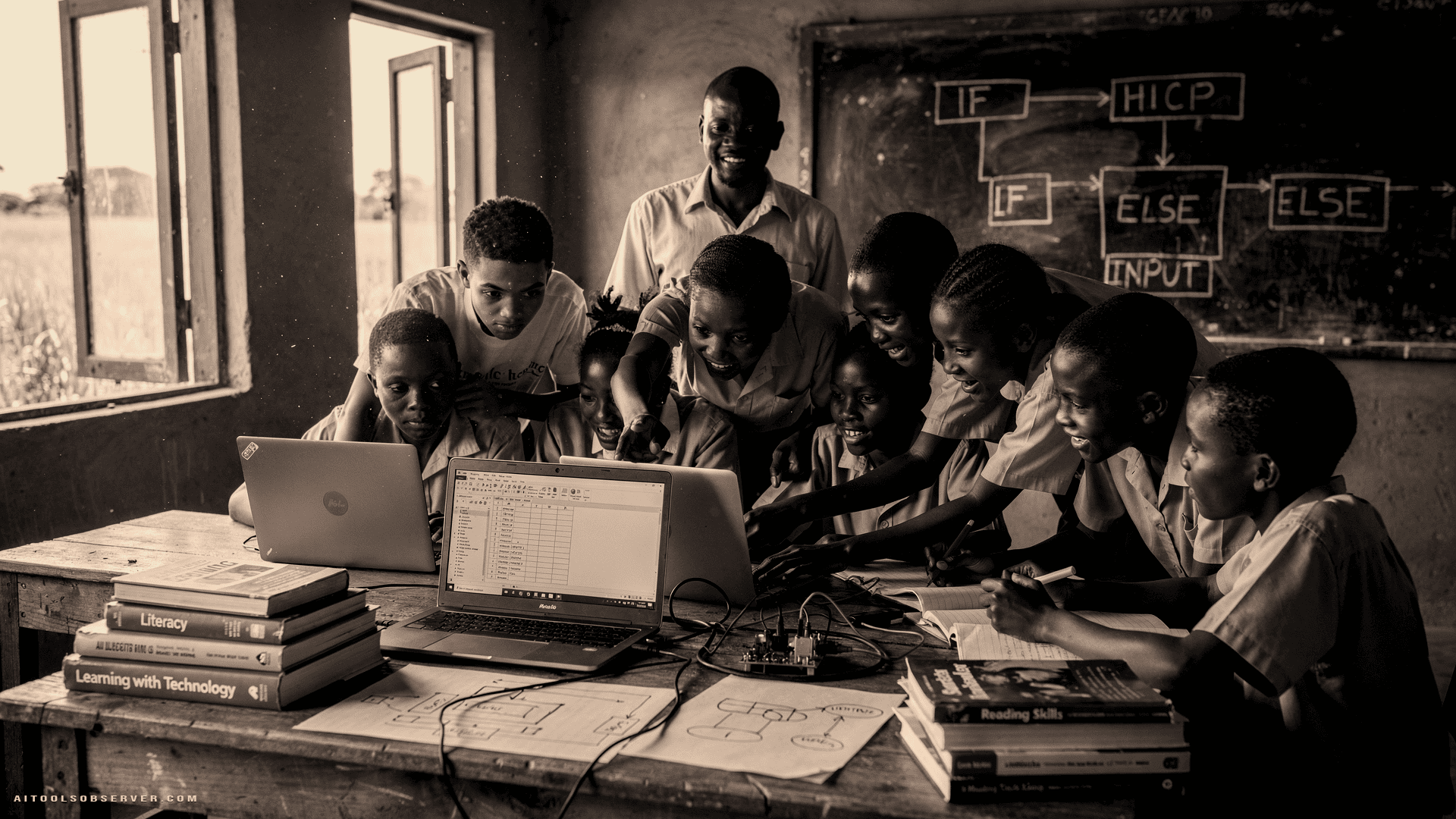
The dominant narrative around AI in K-12 education centers on risk: cheating, academic shortcuts, eroded critical thinking. Ridgewood High School in rural Appalachian Ohio offers a sharply different data point. Seven students, enrolled in an Intel-backed AI course, built a functioning literacy application from the ground up — and in doing so, demonstrated what purposeful AI adoption in education can actually look like.
This case study breaks down how Reading Reimagined was conceived, built, and validated, with particular attention to the tools, process decisions, and structural conditions that made it possible.
A Local Literacy Crisis as the Design Brief

Educator Lester McCurdy’s wife teaches fourth grade in the same district. More than half of her students were on reading improvement plans. That single, concrete data point became the project’s north star.
Rather than selecting a generic AI application topic, the student team grounded their work in a documented, local need. This is a methodologically sound starting point: the problem was specific, measurable in its scope, and personally meaningful to the builders. It also meant the team had direct access to domain experts — teachers — throughout the development cycle.
Phase 1 — Research Before Code

Before writing a single line of logic or prompting any AI model, the students conducted structured research. They interviewed teachers across the district, studied state literacy standards, and investigated the science of reading — including phonics instruction, vocabulary development, and comprehension scaffolding.
This phase is often skipped in student technology projects, yet it proved foundational here. The team’s eventual feature set — vocabulary supports, comprehension tools, dyslexia accommodations — maps directly to established literacy pedagogy rather than to assumptions about what struggling readers need.
Phase 2 — Platform Testing and Abandonment
Joyce and Lahmers confirmed that the team tested multiple platforms and discarded approaches that failed. The article does not specify which platforms were evaluated and rejected, but the pattern itself is significant: the students treated tool selection as an empirical question, not a default choice.
This iterative elimination process is standard in professional product development. Its presence in a high school classroom signals that the pedagogical framing — McCurdy’s startup model — was genuinely shaping student behavior, not just serving as a metaphor.
Phase 3 — Prompt Engineering as a Core Skill

One of the more technically instructive details in the project record is Joyce’s observation:
You just have to be really specific.
This is a precise, if informal, description of prompt engineering — the practice of crafting inputs to AI models with sufficient context, constraints, and clarity to produce reliable outputs.
The students learned this through failure. Content moderation challenges and inconsistent outputs forced them to refine how they communicated with the AI tools they were using. That skill — structuring instructions to produce predictable, safe, and educationally appropriate content — is directly transferable to professional AI workflows.
Phase 4 — Accessibility as a Feature, Not an Afterthought

A classmate with a disability contributed directly to the platform’s accessibility design. This is a meaningful structural decision: including a user with lived experience of the problem in the design process is a recognized best practice in UX and assistive technology development.
The resulting dyslexia supports were not retrofitted onto a finished product. They were built in — a distinction that matters both technically and ethically.
The Technology Stack: What We Know

The source material does not provide a full technical specification of Reading Reimagined’s architecture. Based on available context, the following can be reasonably inferred:
- AI curriculum provider: Intel (course framework and foundational AI literacy)
- Platform partners: AI OWL (Ohio-based AI company) and NWN (AI and cloud infrastructure)
- Core application type: AI-powered literacy platform with personalized story generation, vocabulary scaffolding, comprehension tools, and accessibility features
- Development approach: Iterative, problem-led, with multiple platform evaluations and user testing cycles
The involvement of NWN as a cloud and AI partner suggests the application likely runs on cloud infrastructure, though the specific model or API integrations are not disclosed in the available record.
A Classroom Structured as a Startup

McCurdy’s classroom operated on a product development loop: identify a problem, research it, build a solution, test it, gather feedback, refine. This is not a novel framework — it mirrors design thinking and agile methodologies used in professional software development.
What makes it notable in this context is its execution in a rural Ohio high school with no computer science prerequisite and a teacher without a formal AI background. The methodology transferred because the mindset was right, not because the credentials were.
The Teacher’s Role as Condition-Creator
Raach’s observation —
The person and their mindset prepares you to teach this class
— carries significant weight for districts considering AI curriculum adoption. McCurdy’s value was not technical expertise. It was his ability to create conditions where students could discover answers independently, tolerate ambiguity, and treat obstacles as design problems rather than dead ends.
When the team encountered a delay waiting for external technical support, they did not pause. They used AI to evaluate potential solutions themselves. That response is a direct product of the classroom culture McCurdy built.
External Partners as Enablers, Not Replacements

Three external organizations contributed to the project’s infrastructure: Intel provided the AI curriculum, AI OWL contributed local AI expertise and facilitation, and NWN provided cloud and AI resources. Each played a distinct enabling role without displacing the educators or students at the center of the work.
AI OWL’s Trace Johnson was explicit on this point: outside partners should not attempt to replace educators who understand student needs, local challenges, and pedagogical nuance. The technology companies provided access and capacity. The learning happened because of McCurdy and Raach.
NWN’s CMO Andrew Gilman reframed the standard institutional conversation about AI in schools: rather than leading with compliance and guardrails, he positioned AI as an access and opportunity problem. That framing shaped how the partnership was structured — expansively rather than restrictively.
National Recognition

Reading Reimagined received recognition through the Presidential AI Challenge, a federal initiative connecting K-12 students with public-private AI partnerships. This is an externally validated outcome, not a self-reported success metric.
The students subsequently presented the platform to technology executives, senators, and federal leaders in Washington, D.C. — a high-stakes communication environment that tested skills well beyond coding.
Student Outcomes Beyond the App
Both Joyce and Lahmers reported that the project’s most durable outcome was confidence: in presenting ideas, solving problems, engaging with industry professionals, and trusting that their work merits serious attention.
Neither student plans to pursue a career in technology. That detail is instructive. The project’s value was not in producing future engineers. It was in demonstrating that AI literacy — the ability to work with, evaluate, and direct AI tools toward meaningful ends — is a broadly applicable competency, not a specialist track.
Limitations and Open Questions

Several aspects of this case warrant honest acknowledgment for practitioners considering replication:
Scalability of the teacher profile. The project’s success depended significantly on McCurdy’s specific mindset and Raach’s institutional support. Districts cannot reliably recruit for that combination. Identifying what is trainable versus what is dispositional remains an open question.
Technical documentation gaps. The public record does not include the application’s full technical architecture, the specific AI models or APIs used, or quantitative literacy outcome data for student users. A rigorous evaluation of Reading Reimagined’s effectiveness as a literacy tool would require that evidence.
Sustainability without partnership support. The involvement of Intel, AI OWL, and NWN provided resources that most rural districts cannot independently access. The model’s replicability depends on whether similar partnerships can be systematically brokered at scale.
Content moderation complexity. The students themselves identified content moderation as a significant challenge during development. For a platform targeting struggling readers, including young children, this is not a minor technical footnote — it is a core safety requirement that would need rigorous ongoing management in any deployment.
The Inversion of the Standard AI Risk Narrative

The Ridgewood case does not disprove concerns about AI misuse in education. It demonstrates that the same tools associated with academic dishonesty can, under different structural conditions, produce the opposite outcome: deeper subject matter engagement, stronger research habits, and genuine problem-solving capability.
The variable is not the tool. It is the design of the learning environment around the tool.
Prompt Specificity as a Transferable Skill
The students’ discovery that effective AI use requires precise, structured communication is one of the most practically transferable findings in this case. Whether the context is a literacy app, a marketing workflow, or a data analysis task, the underlying skill — knowing how to instruct an AI system to produce reliable, appropriate output — is consistent across domains.
Access as the Primary Equity Lever

Gilman’s framing of AI as an access and opportunity problem, rather than a compliance problem, has direct implications for how rural and under-resourced districts approach AI adoption. The Ridgewood students were not exceptional because of their geography or their resources. They were exceptional because someone gave them access, a meaningful challenge, and the conditions to work through failure.
Final Assessment

Reading Reimagined is not a polished commercial product. It is a proof of concept with real technical depth, genuine pedagogical grounding, and measurable student impact — built by teenagers in a district that, by most conventional metrics, would not be expected to produce it.
For AI tool observers, the more important story is structural. The conditions that made this project possible — a problem-led curriculum, a trust-based classroom culture, external partnerships framed around access rather than restriction, and educators selected for mindset over credentials — are reproducible. They require intention, not budget.
McCurdy’s formulation remains the sharpest summary of what this project demonstrated:
If you’re using it to get yourself better, then it becomes a powerful tool.
That principle applies equally to a student in rural Ohio and to any professional evaluating which AI tools belong in their workflow.











Comments (0) No comments yet
Want to join this discussion? Login or Register.
No comments yet. Be the first to share your thoughts!