


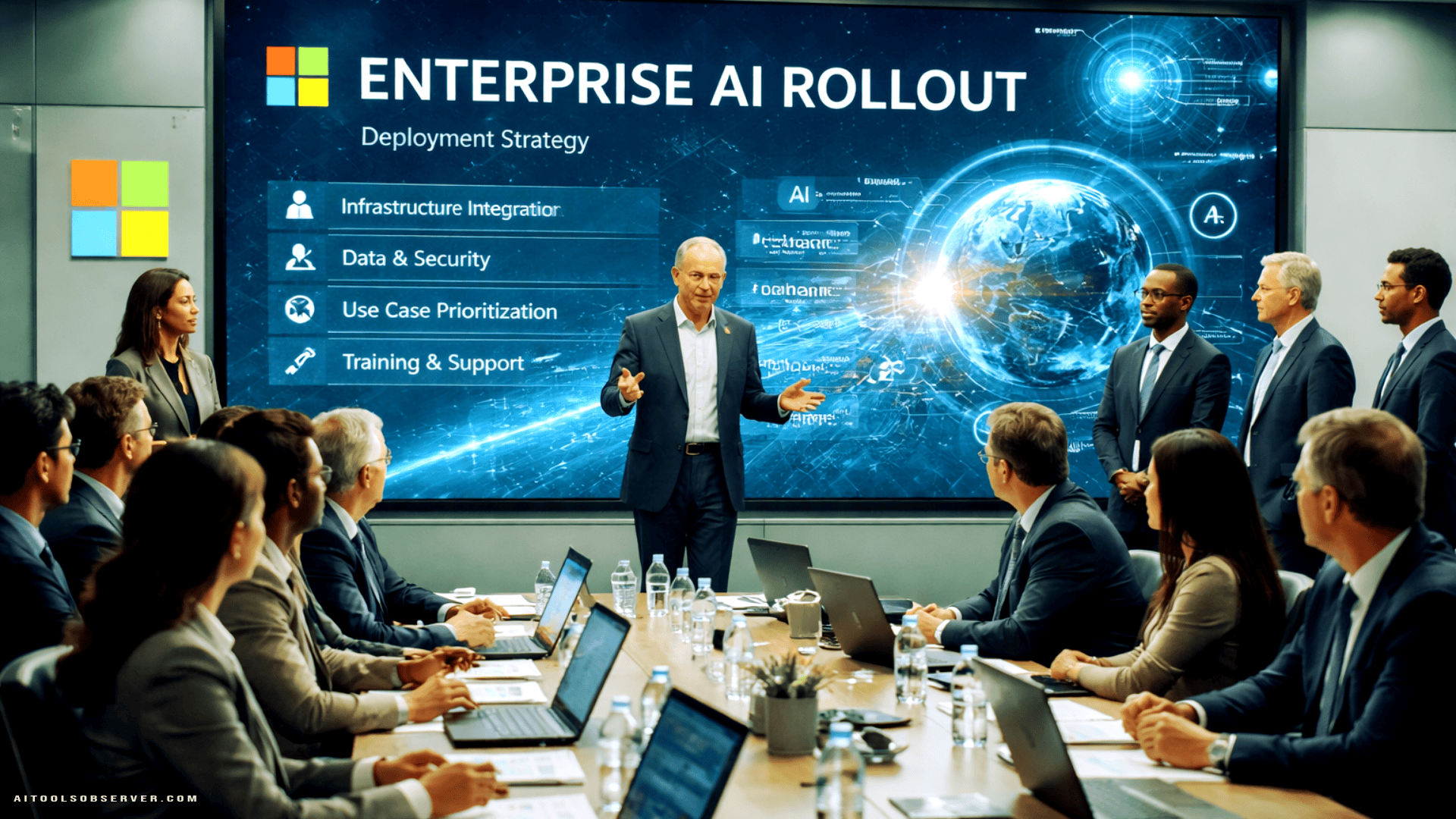
What Is Microsoft Frontier Co.?

Frontier Co. is Microsoft’s new forward deployed engineering (FDE) unit. The 6,000-person team will embed directly with clients, combining existing FDEs, technical consultants, industry-specific salespeople, and support staff under one roof.
Rodrigo Kede Lima, who previously led Microsoft’s Asia business, will serve as president of the new division. The unit pulls together resources Microsoft already had scattered across the organization and gives them a unified mission: get enterprise customers from AI curiosity to AI execution.
Judson Althoff, CEO of Microsoft’s commercial business, framed the problem bluntly. Customers are “in very different places right now, and trying to really figure out AI.” The questions they’re wrestling with — which model to use, how to integrate with existing systems, how to protect proprietary data — aren’t technical questions. They’re strategic ones. And that’s exactly the gap Frontier Co. is designed to close.
The FDE Model Is Becoming the New Consulting Playbook

Forward deployed engineering isn’t a new concept. Palantir popularized the job title years ago, embedding engineers directly inside government and enterprise clients — including U.S. military bases in Afghanistan. The model works because complex software doesn’t implement itself.
Now every major AI player is racing to replicate it.
Just two days before Microsoft’s announcement, Amazon committed $1 billion to its own FDE initiative. Anthropic and OpenAI both launched FDE groups in May 2026, partnering with private equity firms, banks, and consulting firms. Accenture and EY have already announced alliances with Microsoft on AI-centric FDE programs.
The pattern is clear: the AI industry is shifting from selling tools to selling outcomes. And outcomes require humans on the ground.
Why Microsoft Is Making This Move Now
Microsoft’s stock has dropped 21% in 2026 — the worst performance among mega-cap tech companies by a significant margin. Wall Street is nervous that AI-powered coding tools could erode demand for mature software products. GitHub Copilot has lost market share to newer competitors. Microsoft 365 Copilot hasn’t achieved the enterprise ubiquity Microsoft projected.
The $2.5 billion Frontier Co. investment is partly a response to that pressure.
Microsoft has already poured tens of billions into data center infrastructure and generative AI services. The infrastructure is there. The models are there. What’s been missing is a scalable, structured way to turn that investment into measurable enterprise value — and into revenue that Wall Street can see.
Frontier Co. is the answer to that missing piece.
What This Means for the Enterprise AI Tools Market
This move reshapes the competitive landscape in a few important ways.
Implementation becomes a moat. As AI tools commoditize, the ability to deploy them effectively becomes the differentiator. Microsoft is betting that deep client relationships — built through embedded FDE teams — will lock in enterprise customers more durably than any single product feature.
The consulting industry faces new pressure. Traditional systems integrators and consulting firms have long owned the enterprise implementation layer. Microsoft entering this space directly — with $2.5 billion and 6,000 people — changes the economics of that market overnight.
Multi-model flexibility is the pitch. Althoff was direct about how Frontier Co. differentiates from Palantir:
“More models, more connectors to data, more integrations with open systems of record.”
Microsoft isn’t pushing customers toward one model or one vendor. It’s positioning itself as the neutral implementation layer across the entire AI ecosystem — OpenAI, Anthropic, and beyond.
What AI Adopters Should Take Away
If you’re evaluating enterprise AI tools right now, this announcement signals something important: the implementation gap is real, and the market is finally pricing it in.
The best AI tool for your business isn’t necessarily the most powerful one — it’s the one your team can actually deploy, integrate, and scale within your existing operations. That’s the problem Microsoft is trying to solve at enterprise scale.
For founders and operators building on top of AI, watch how Frontier Co. evolves. The clients Microsoft embeds with will shape which tools get standardized, which integrations get prioritized, and which use cases get productized next. That’s a signal worth tracking.
The race to build AI models is far from over. But the race to make those models work inside real businesses — that race just got a $2.5 billion head start.













Comments (0) No comments yet
Want to join this discussion? Login or Register.
No comments yet. Be the first to share your thoughts!