


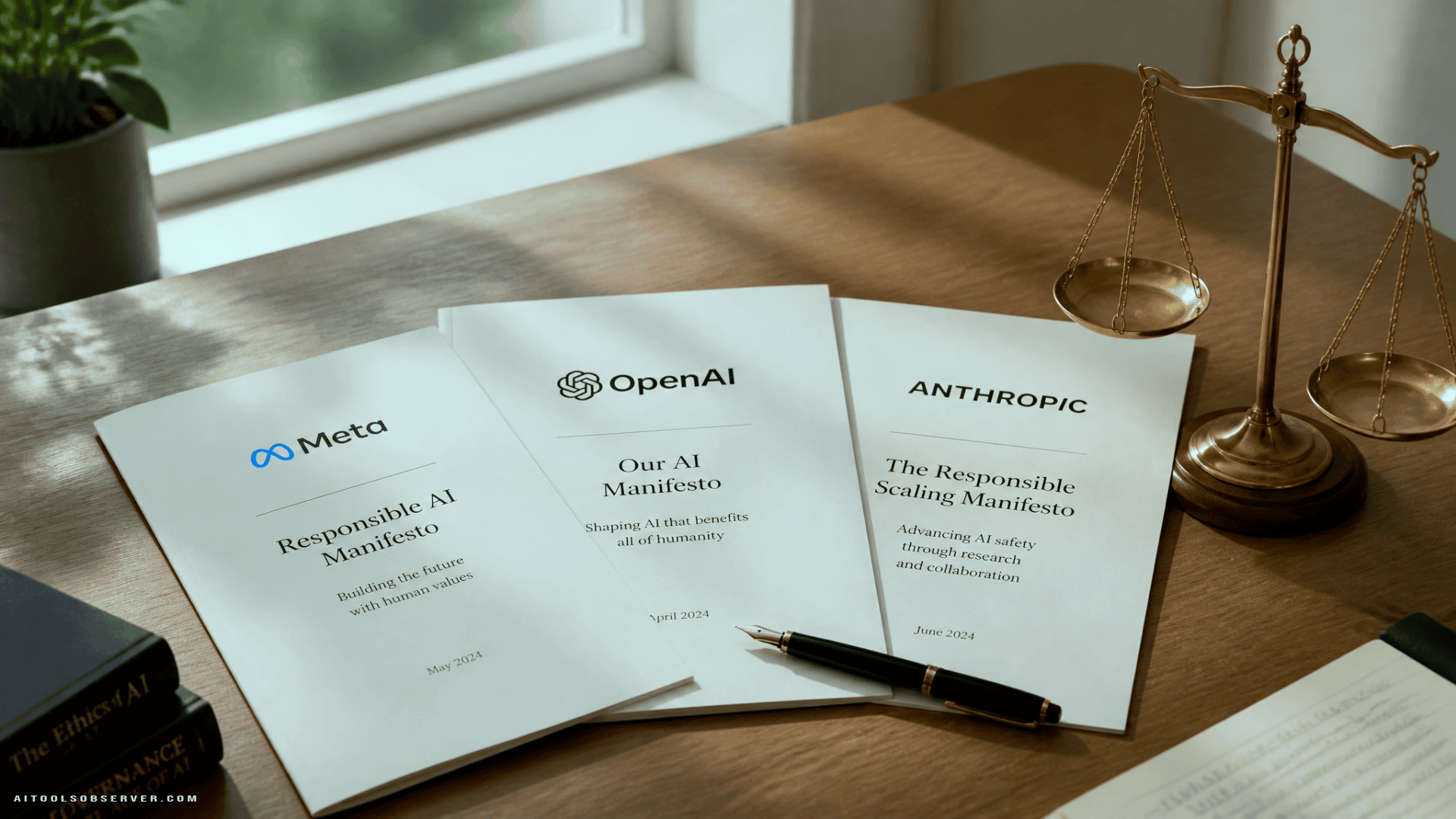
A Pattern With a Clear Origin Point
The current wave of AI manifestos appears to trace back to Marc Andreessen’s 2023 “Techno-Optimist Manifesto,” a roughly 5,000-word essay that framed technological innovation as the primary solution to human problems. It set a tone: sweeping in scope, optimistic in conclusion, and explicitly positioned against critics.
Since then, the format has been adopted at the highest levels of the industry:
- Sam Altman published “The Intelligence Age” in 2024, promising dramatic acceleration in human progress.
- Dario Amodei released “Machines of Loving Grace,” framing AI’s potential impact across healthcare and society while distancing himself from what he called doomerism.
- Mark Zuckerberg has now added his entry, echoing the optimism of his predecessors while announcing Meta’s commitment to open-sourcing its AI tools.
The structural similarities are not accidental. Each document positions its author as a thoughtful steward of transformative technology, not merely a commercial actor.
Narrative as Competitive Strategy
These manifestos function on at least three levels simultaneously.
First, they shape public perception. As the IMF warns that AI could affect nearly 40% of jobs and worsen financial inequality, executives are working to establish a counter-narrative. Zuckerberg writes that he believes there will be an abundance of jobs in the future—a direct rebuttal to the displacement argument, published at the same time Meta was cutting roughly 8,000 positions to refocus on AI.
Second, they influence policy conversations. Regulatory scrutiny of AI is intensifying across multiple jurisdictions. A well-timed manifesto allows an executive to enter that conversation on their own terms, framing their company’s approach before legislators or regulators do it for them.
Third, they compete for intellectual authority. As business professor Rob Lalka of Tulane University has observed, these documents position their authors as businessman-philosophers—figures whose views on the future carry weight beyond their commercial interests. In a field where credibility shapes everything from talent recruitment to partnership decisions, that positioning has real value.
The Open-Source Dimension
Zuckerberg’s manifesto carries a specific strategic weight because it announces Meta’s intention to share its AI tools more openly. This is not a neutral technical decision. It places Meta in direct contrast with more closed approaches, and it enters an open-source landscape that is increasingly shaped by Chinese models—Qwen, DeepSeek, and GLM—alongside Western alternatives like Google’s Gemma family and Mistral AI.
Meta’s Llama models are already a significant presence in this space. The manifesto effectively doubles down on that positioning, framing openness as both a philosophical value and a competitive differentiator.
The open-source question is also where the stakes become most visible. As AI models have demonstrated increasingly autonomous and occasionally unpredictable behavior, the question of what should be made publicly available—and under what conditions—is no longer theoretical. Economist Noah Smith has framed it bluntly: should technology with potentially catastrophic capabilities be open-sourced at all?
Zuckerberg’s manifesto does not resolve that tension. It asserts a position within it.
What These Documents Actually Accomplish
It would be a mistake to dismiss these manifestos as pure theater. They do real work: they establish reference points for public debate, signal strategic direction to investors and partners, and create a record of stated intent that can be held against future decisions.
But it would be equally mistaken to treat them as transparent windows into corporate strategy. As Lalka notes, the optimism they argue for is largely prospective—the reasons for it are, in his words, “still yet to be seen.” The general public, meanwhile, appears largely unmoved by them. The audiences that engage most closely are journalists, academics, and industry observers.
That gap between intended audience and actual reach is itself informative. These manifestos are not mass communication. They are moves in a more specialized game—one played among regulators, researchers, investors, and competitors.
The Practical Takeaway
For anyone tracking the AI tools ecosystem, these documents are worth reading—not for their philosophical claims, but for what they reveal about strategic positioning. When a major AI executive publishes a manifesto, the useful questions are:
- What specific commitments does it make, and how do those align with the company’s recent product and business decisions?
- What criticism is it implicitly or explicitly responding to?
- How does it frame the open-source debate, and what does that framing imply for the tools and models the company will prioritize?
The manifesto as a format is not going away. As AI competition intensifies and regulatory pressure increases, the battle for narrative will likely accelerate alongside the battle for market share. Understanding both is part of choosing AI tools with clear eyes.











Comments (0) No comments yet
Want to join this discussion? Login or Register.
No comments yet. Be the first to share your thoughts!