


ChatGPT Holds a Commanding Lead

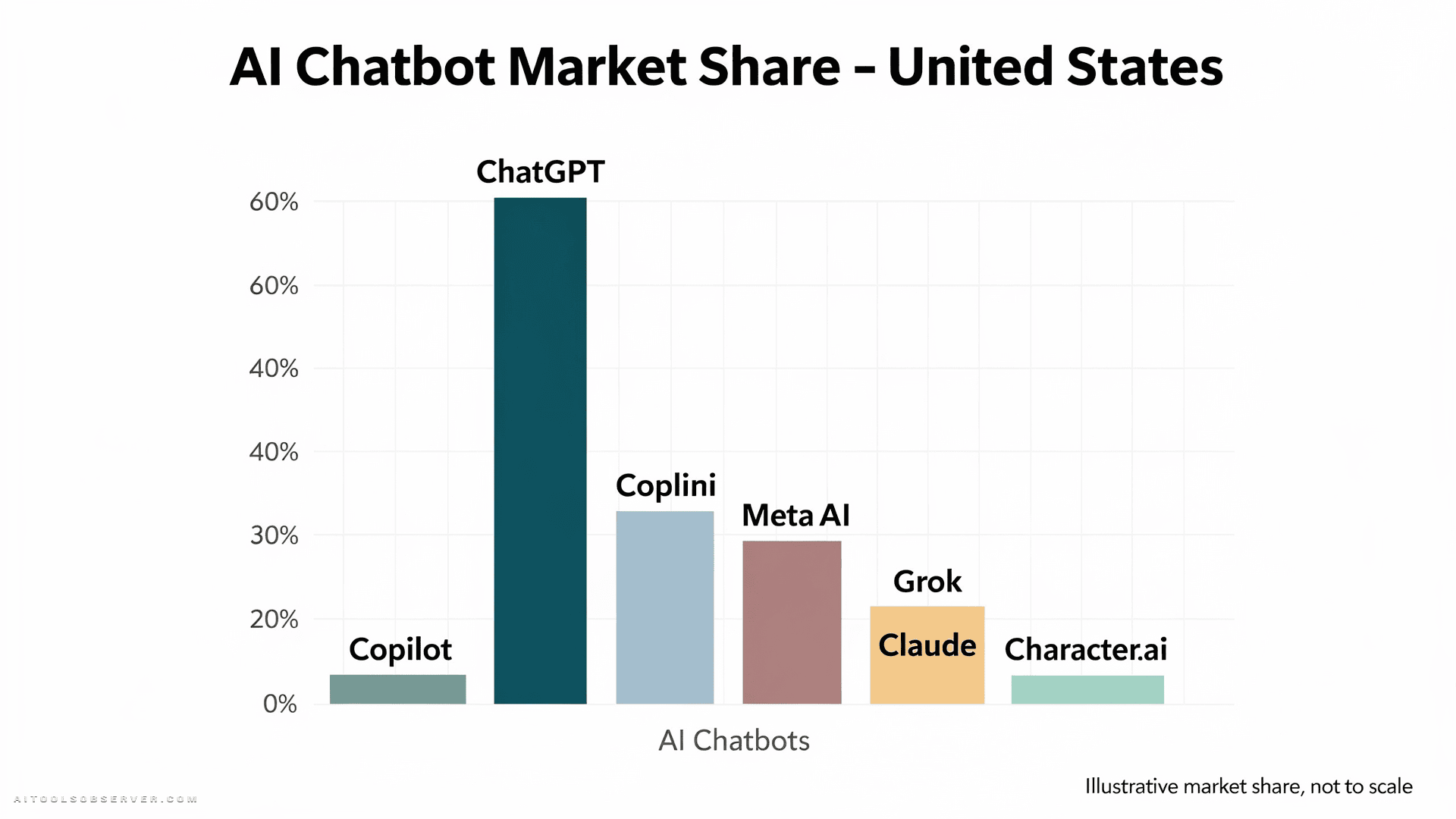
Among U.S. adults who report using AI chatbots, 44% use ChatGPT. No other platform comes close.
AI chatbot usage among U.S. adults (ever used):
- ChatGPT — 44%
- Gemini — 24%
- Copilot — 14%
- Meta AI — 17%
- Grok — 8%
- Claude — 6%
- Character.ai — 3%
Source: “Americans and AI 2026: Chatbots, Smart Devices and Views on Impact,” Pew Research Center
The first-mover advantage is unmistakable. ChatGPT launched into a vacuum, became synonymous with the category, and has since built a usage habit that competitors are struggling to displace. Gemini, backed by Google’s distribution muscle, reaches 24% — a respectable figure, but still less than half of ChatGPT’s share.
Claude has attracted considerable industry attention and critical praise for its reasoning capabilities. Yet at 6%, its real-world adoption among the general public remains limited. Mindshare among developers and power users does not automatically translate into mainstream penetration.
Search Remains the Primary Use Case
The more revealing finding may be how people are using these tools, not just which ones they choose.
The dominant use case is search and information retrieval. The majority of AI chatbot users are turning to these tools primarily to find answers — a behavior that mirrors traditional search engine usage rather than the more sophisticated workflows that enterprise and developer communities discuss.
Image and video generation, despite relentless platform investment and social media integration, reaches only 24% of chatbot users. The gap between feature availability and actual adoption is significant. Platforms are building capabilities that most users are not yet reaching for.
Productivity Gains Are Real, but Modest
Thirty percent of respondents said AI chatbots improve their productivity and help keep them informed. Americans are more likely to say chatbots help rather than hurt across productivity, knowledge, and creativity dimensions.
That is a meaningful signal. It confirms that AI tools are delivering tangible value — not merely generating curiosity clicks.
However, the scope of that value remains narrow for most users. Productivity gains are concentrated in discovery and information tasks. The deeper workflow integrations — drafting, analysis, code generation, decision support — are not yet the norm for the average American adult.
AI Overviews Are Reshaping Search Behavior

One of the survey’s more consequential findings concerns AI-generated search summaries.
How Americans engage with AI overviews in search results:
- Read them — 60%
- Do not read them — 30%
- Not sure — 10%
Source: “Americans and AI 2026: Chatbots, Smart Devices and Views on Impact,” Pew Research Center
A 60% engagement rate with AI summaries is not a marginal phenomenon. It indicates that the search experience is being fundamentally restructured in the perception of the majority of users, even if click-through behavior has not collapsed as dramatically as some publishers feared.
Google stated in August 2025 that AI overviews were not significantly reducing referral traffic, arguing that users shown AI summaries actually engaged with a broader range of links. The Pew data does not contradict that claim directly, but it does confirm that users are reading and relying on AI-generated answers at the top of results pages. The long-term implications for content discovery and web traffic remain an open question.
The category leader is entrenched — for now
A 44% share in a fragmented, fast-moving market is a structural advantage, not just a momentary lead. For any tool competing with ChatGPT, the challenge is not feature parity — it is habit displacement. That is a harder problem to solve than engineering.
Adoption is broad but shallow
The data suggests that AI adoption in the US is wide in reach but limited in depth. Most users are at the awareness and basic utility stage. The transition to embedded, workflow-level AI usage — the scenario that justifies enterprise valuations — has not yet occurred at scale for the general population.
Image generation is not the mass-market use case
Platforms and investors have poured resources into generative image and video tools. The 24% usage figure should prompt a recalibration of assumptions about consumer demand. Creative generation tools may have a strong ceiling unless they are embedded invisibly into existing workflows rather than offered as standalone features.
Search is the gateway — and the battleground
The fact that most users come to AI chatbots for search-like behavior explains why Google, Microsoft, and Meta are all competing aggressively in this space. Whoever owns the search habit owns the entry point to deeper AI engagement. The 60% AI overview readership figure reinforces that this battle is already well underway.
The Measured Reality of a Major Shift
Pew’s 2026 benchmarks are a useful corrective to both excessive optimism and excessive skepticism about AI adoption. The shift is real — but it is proceeding at a human pace, shaped by habit, trust, and practical utility rather than by the speed of product releases.
ChatGPT’s dominance reflects a simple truth: the tool that made AI accessible to ordinary users first built a durable advantage. The tools that follow will need to offer something meaningfully different, not merely technically superior, to close that gap.
For founders building in this space, marketers allocating AI budgets, and professionals evaluating which tools to adopt — the Pew data offers a grounding benchmark. Know where the average user actually is, not where the most engaged early adopters have already arrived.












Comment (1)
Want to join this discussion? Login or Register.
This is one of the clearer overviews I've seen on current AI chatbot adoption. The comparison between ChatGPT, Copilot, Claude, Grok, and other assistants really puts the market into perspective. It will be interesting to see how these numbers evolve as AI search continues to replace traditional search for more users. Great analysis and well-presented charts!