



What Egocentric Video Actually Is — and Why It Matters

Egocentric video is first-person footage that captures exactly what a person sees while performing a task. It is not a camera mounted on a tripod across the room. It is the view from your own eyes — hands in frame, environment shifting, intent embedded in every motion.
That distinction is critical for robot training. Traditional video shows what happens. Egocentric video shows how it feels to do it. Robots learning to fold laundry or prep food need that granular, embodied perspective to imitate human behavior without step-by-step programming.
This is why companies are paying workers to film themselves doing chores. The data is irreplaceable, and right now, humans are the only reliable source of it.
The Companies Turning Chores Into Training Data

Two players sit at the center of this emerging supply chain.
Objectways, founded by Ravi Shankar, operates as a data-labeling company with deep ties to US tech clients. Workers film micro-tasks inside staged homes and factory mockups. Colleagues then annotate each frame into machine-readable steps — labeling hand positions, object interactions, and task sequences. The output feeds teams building household robots and warehouse systems, reportedly including platforms like Amazon.
Humyn Lab, based in Bangalore, operates in the same space, recruiting workers to generate egocentric datasets at scale. Both companies represent a growing tier of AI infrastructure that sits between raw human behavior and the polished models that ship in consumer products.
The workflow is deceptively simple: film, annotate, deliver. But the downstream value is enormous.
The $38 Billion Market Driving Demand
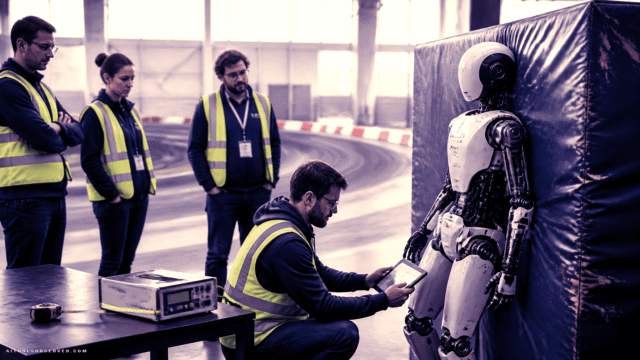
Goldman Sachs projects the humanoid robot market will hit $38 billion by 2035, assuming hardware costs continue to fall and general-purpose AI models keep improving. That forecast is pulling serious capital into the space.
But hardware is only part of the equation. Robots need data — massive volumes of clean, diverse, real-world behavior data — before they can generalize across environments. A robot trained only on footage from one kitchen will fail in another. US teams need varied hands, lighting conditions, cultural contexts, and task types to build models that don’t break in the real world.
India offers exactly that at a fraction of the cost. The economics are hard to argue with, which is why this market is scaling fast.
The Ethical Fault Lines Running Through the Supply Chain
Scale does not erase the hard questions. It amplifies them.
Privacy Without Clear Rules
Privacy without clear rules
Egocentric footage captured inside homes and kitchens is intimate by definition. Workers themselves are drawing informal boundaries — avoiding bedrooms, declining to film family members — because formal rules often don’t exist yet. Questions about data retention, licensing, and whether footage will be recycled into future commercial models without additional compensation remain largely unanswered.
When a dataset trained on someone’s kitchen ends up inside a $3,000 household robot sold in the US, who owns that moment?
The Pay Equity Gap
The distance between $2.40 an hour and a high-margin robotics product is not just an economic gap — it is a policy conversation waiting to happen. The AI boom is replicating a pattern the tech industry has seen before: low-cost labor enables premium products, and the contributors rarely share in the upside.
Ride-hailing and content moderation went through the same reckoning a decade ago. AI data labor is next. Policymakers, enterprise buyers, and AI ethics teams are starting to ask whether datasets that underpin billion-dollar markets should command higher wages for the people who generate them.
These are not abstract concerns. They are the kind of questions that eventually reshape procurement decisions and regulatory frameworks.
What This Means for the AI Tools Ecosystem
If you are building, buying, or evaluating AI tools — especially anything in the robotics, computer vision, or embodied AI space — this supply chain is relevant to you right now.
Data provenance is becoming a competitive differentiator. As scrutiny on training data increases, tools and platforms that can demonstrate ethical sourcing, fair compensation, and clear licensing will have an edge. Buyers are starting to ask these questions, and that pressure will only grow.
The annotation layer is underbuilt. Egocentric video labeling is specialized, expensive to do well, and still largely manual. Tools that can accelerate or semi-automate this workflow — while maintaining quality — represent a real market opportunity. Watch for AI-assisted annotation platforms targeting robotics use cases specifically.
Humanoid robot timelines are compressing. The $38 billion projection assumes continued progress on both hardware and data. If egocentric dataset pipelines mature faster than expected, robot capabilities could scale ahead of schedule. That has downstream implications for warehouse automation, home robotics, and any workflow that currently requires a human body.
The Cameras Keep Rolling
One mango slice at a time, one towel fold at a time, workers in India are teaching machines how humans live. The footage is mundane. The implications are not.
The humanoid robot market is being built on a foundation of low-wage human behavior data, and the industry has not yet reckoned with what that means — for the workers generating it, for the companies profiting from it, or for the regulators who will eventually catch up.
The AI tools ecosystem moves fast. But the ethical infrastructure around data labor is moving slower. That gap is where the next major disruption in this space will come from — and the smartest players are already paying attention.
















Comments (0) No comments yet
Want to join this discussion? Login or Register.
No comments yet. Be the first to share your thoughts!