



The Problem With Giving Everyone an AI Agent

AI agents aren’t just chatbots. They browse, click, transact, assess risk, and send emails — all at machine speed, with minimal human hand-holding. That’s enormously useful. It’s also enormously risky if nobody’s watching.
GovTech CEO Goh Wei Boon put it plainly: you need “a layer of customisable rules, sanctioned AI tools, and a registry to provide better visibility and security.” Translation — before you hand 150,000 civil servants an autonomous digital co-worker, you probably want to know what it’s doing.
That’s the core problem the AI Assistant Desk is designed to solve.
What the AI Assistant Desk Actually Is

Think of it as a secure, managed environment for AI tools inside the Singapore government. Not a single product — a suite.
The key components:
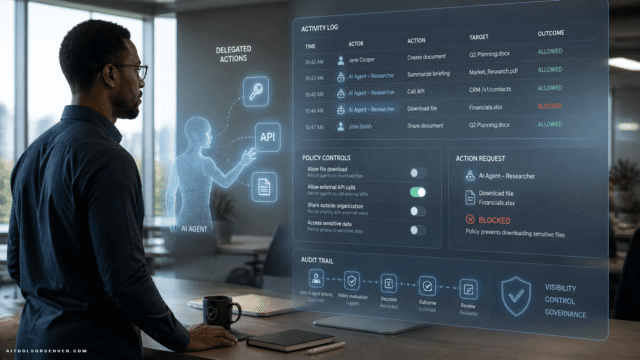
- An AI agent registry — tracks who owns which agent and what it’s doing
- Customisable security rules — block file deletions, restrict external emails, cap recipient lists
- Automated hygiene checkers — scan prompts and outputs for offensive language
- Sanctioned tool lists — third-party AI tools can be swapped in or out without breaking the security layer
The last point matters more than it sounds. Most enterprise AI deployments break when you change the underlying model or vendor. GovTech’s architecture keeps the guardrails intact regardless of what’s running underneath. That’s good infrastructure thinking.
A Registry for AI Agents — Why It’s a Big Deal

The AI agent registry is the most forward-looking piece of this puzzle.
As agents proliferate — each one capable of autonomous action across government systems — accountability becomes genuinely hard. Who authorised this agent? What data did it touch? Why did it send that email?
A registry answers those questions before they become incidents. It’s the difference between AI governance as a policy document and AI governance as an operational reality.
This kind of agent-level accountability is something most private-sector deployments haven’t figured out yet. Singapore is building the infrastructure while the rest of the world is still debating the framework.
From Hackathon to Classroom: AI in the Wild

GovTech’s inaugural {build} hackathon in 2025 pulled in 600 public servants. Two prototypes are already in schools.
Markly is an AI marking assistant being trialled in 18 schools. It helps teachers mark handwritten English and geography scripts faster and more consistently — with plans to integrate into Google Classroom and the existing Student Learning Space platform.
LangBuddy is a voice-enabled chatbot that converses with students in Mandarin, Malay, and Tamil. If a student sneaks an English phrase into a Mandarin sentence, LangBuddy catches it and offers the translation. Around 300 students across 10 schools are currently testing it.
These aren’t proof-of-concept demos. They’re real tools, in real classrooms, built by civil servants at a hackathon. That’s a meaningful signal about what happens when you give non-engineers low-code AI tools and a problem to solve.
The Cybersecurity Play: Automated Pen Testing at Scale

Here’s where it gets genuinely interesting for anyone thinking about AI in security workflows.
GovTech manages roughly 2,000 government systems containing citizen data. Traditional penetration testing — simulated hacking to find vulnerabilities before real hackers do — takes months per engagement. Test annually, and you’re only secure once a year. That’s not a security posture; that’s a prayer.
Since January 2026, GovTech has been running automated penetration testing tools. The goal: continuous testing across all government systems, not a yearly snapshot.
The urgency isn’t theoretical. In 2025, the cyberespionage group UNC3886 attacked Singapore’s telcos. That kind of threat doesn’t wait for your annual audit cycle.
Since October 2025, GovTech has also been layering AI into its threat detection tools — proactively flagging traffic anomalies to catch stealthy intrusions earlier. The shift is from reactive patching to continuous, AI-driven vigilance.
The Bigger Picture: AI Fluency as National Infrastructure

Singapore’s target is 100,000 AI-fluent individuals across all sectors by 2029. Not just engineers — professionals who can combine domain expertise with AI know-how to solve real problems.
More than half of the 150,000 public officers already regularly use Pair, the government’s AI chatbot, for productivity, writing, and research. GovTech’s 1,600 embedded engineers are using AI-assisted coding tools. Non-engineering teams are picking up low-code AI tools. The {build} hackathon is now a recurring event.
The pattern is deliberate: build fluency from the ground up, not just from the top down.
What Other Organisations Can Learn From This
You don’t need to be a national government to take notes here. A few principles worth borrowing:
Security layers should be tool-agnostic. If your AI governance breaks every time you switch vendors, it’s not governance — it’s a dependency.
Agent registries are coming. If you’re deploying AI agents at any scale, start thinking now about how you’ll track ownership, permissions, and activity. The audit trail matters.
Continuous testing beats periodic testing. This applies to AI systems as much as traditional software. If you’re only evaluating your AI tools once a year, you’re flying blind the other 364 days.
Hackathons with real deployment pipelines are different from hackathons without them. Markly and LangBuddy exist because GovTech built a path from prototype to production. Most hackathon projects die in a slide deck.
The Takeaway
Singapore is doing something rare: treating AI deployment as an infrastructure problem, not just a productivity opportunity.
The AI Assistant Desk isn’t flashy. It’s a registry, a set of rules, and a security layer. But that’s exactly the point. The most durable AI deployments aren’t the ones with the most impressive demos — they’re the ones with the most boring, reliable guardrails underneath.
Observe what GovTech is building here. The public sector is usually last to move on technology. This time, it might be worth following their lead.















Comments (0) No comments yet
Want to join this discussion? Login or Register.
No comments yet. Be the first to share your thoughts!