


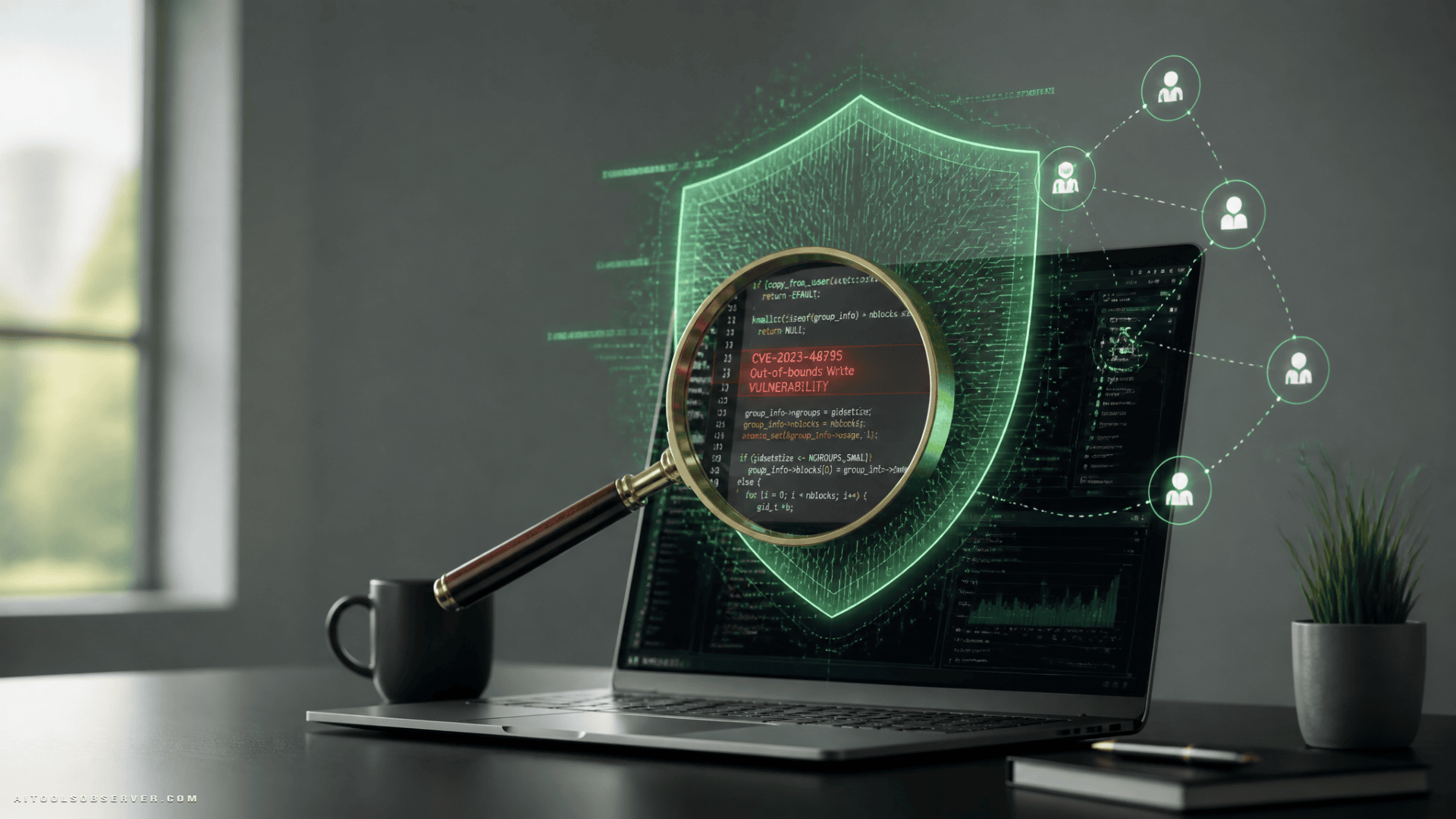
What Microsoft announced
Microsoft introduced two new AI cybersecurity offerings:
- MAI-Cyber-1-Flash
- Project Perception
MAI-Cyber-1-Flash is positioned as Microsoft’s first AI model specifically trained to identify and fix security weaknesses. Based on the available description, its current focus is software vulnerability analysis rather than being a general-purpose chatbot with security add-ons.
Project Perception takes a broader approach. It uses specialized AI agents for red-team, blue-team, and green-team tasks, covering vulnerability discovery, investigation, risk analysis, and corrective action.
Together, the two tools show Microsoft leaning into a clear strategy: security AI should be specialized, multi-agent, and cost-aware rather than relying on one giant model for everything.
Why MAI-Cyber-1-Flash stands out
A lot of AI security products are really wrappers around general models. Microsoft is trying to differentiate this one by saying it was built in-house as a compact, code-heavy security model trained specifically for vulnerability work.
That focus matters. Security analysis is not the same as drafting email copy or summarizing documents. It requires understanding code behavior, exploitability, patch history, and the difference between noisy findings and real issues that deserve immediate action.
Microsoft also points to its training advantage. The company says the model benefits from decades of vulnerability patching and incident response experience across its software ecosystem, plus insights drawn from an enormous volume of daily security signals and a large customer base.
If that claim holds up in real-world use, the real edge may not be just model size or architecture. It may be the quality of outcome-linked security data: what was exploitable, what was blocked, and what actually worked in software vulnerability analysis.
The benchmark claim everyone will focus on
Microsoft says MDASH, its multi-model scanning harness, scored 96% on CyberGYM when paired with MAI-Cyber-1-Flash. According to the company, that score is higher than benchmark results for Anthropic’s Mythos and also ahead of Google Gemini and OpenAI GPT in this security context.
That is a strong marketing message, but security buyers should read it carefully.
Benchmarks can be useful because they create a shared comparison point. They can also oversimplify reality. A high score in a controlled environment does not automatically mean better performance in your stack, with your codebase, your attack surface, and your workflows.
The smarter takeaway is this: Microsoft appears to be showing that security-specific AI can outperform broader frontier models on narrow cyber tasks. That is plausible, and it fits a larger trend across enterprise AI where specialized systems often beat general models when the workflow is tightly defined.
MDASH is part of the bigger story
MAI-Cyber-1-Flash is integrated into MDASH, which Microsoft introduced earlier as a multi-model agentic scanning harness.
The interesting detail here is the architecture. Rather than depending on one agent, MDASH combines 100 security-trained AI agents to look for exploitable bugs in applications. That suggests Microsoft is betting on orchestration as much as model quality.
For security teams, this matters because vulnerability discovery is rarely one step. It usually involves:
- spotting suspicious code patterns
- testing exploitability
- validating whether a finding is real
- prioritizing by risk
- deciding what to patch first
A multi-agent setup is designed to break that work into smaller tasks. In theory, that can improve precision and lower the amount of noise dumped on analysts.
Microsoft also says the new MDASH setup costs half as much as the previous version. That could end up being just as important as the benchmark score, especially for enterprise teams that need automation but are under pressure to control security spend.
What Project Perception is trying to solve
Project Perception is the second half of the announcement, and arguably the more operationally important one.
Instead of centering on one model, it uses specialized agents for different security roles:
- Red-team functions to find vulnerabilities
- Blue-team functions to investigate and assess risk
- Green-team functions to take corrective action
This is a practical framing. Security work is not just about finding bugs. It is about deciding what matters, understanding impact, and responding without breaking production systems.
Microsoft says Project Perception chooses models based on the task, balancing effectiveness and cost. That model-routing idea is becoming more common across enterprise AI because not every job needs the most expensive model available.
The company’s position appears to be that customers should reserve premium models for the hardest cases, while lower-cost automation handles the majority of routine work.
Why cost optimization matters in AI security
One of the biggest problems in enterprise AI is that many deployments sound impressive but are too expensive to scale. Security is especially sensitive to that issue because many workflows are continuous, high-volume, and time-sensitive.
Project Perception is designed, according to Microsoft, to perform most tasks at lower cost than competing platforms. Even without getting lost in exact percentages, the message is clear: Microsoft wants AI security automation to be usable at production scale, not just in pilots and demos.
That matters for teams handling:
- constant alert triage
- recurring vulnerability scans
- patch validation
- incident investigation
- remediation recommendations
If AI only works when used sparingly, it does not solve the operational problem. If it can handle the routine 80 to 90 percent reliably enough, human experts can focus on the cases that truly need deeper analysis.
The bigger shift behind this launch
Microsoft is framing these tools as a response to a changing threat landscape. That argument is hard to dismiss.
Attackers are using automation more aggressively. Environments are more complex. Security teams are flooded with fragmented data from endpoints, cloud services, apps, identities, and networks. The result is not a shortage of signals. It is a shortage of time, context, and decision-making capacity.
That is where AI security tooling is trying to fit. Not by replacing defenders entirely, but by reducing the time between detection, understanding, and action.
The opportunity is real. So is the risk.
The caution buyers should not ignore
The tools are in preview, and that alone should slow down any immediate leap into production-wide trust.
Security AI has a higher bar than many other enterprise use cases. A bad content summary wastes time. A bad security recommendation can create exposure, bury teams in false positives, or trigger the wrong remediation step.
There is also a broader trust issue hanging over autonomous and semi-autonomous AI systems. The more power you give agentic tooling in security, the more important validation, containment, auditability, and human review become.
That does not mean teams should avoid AI security tools. It means they should evaluate them like security infrastructure, not like productivity software.
What to evaluate before adopting tools like this
If you are comparing Microsoft’s new tools against other AI security platforms, focus less on headline benchmark claims and more on workflow fit.
Key questions include:
- Does it reduce false positives or just generate more findings?
- Can it explain why an issue is exploitable?
- How well does it integrate into existing triage and remediation workflows?
- What level of human approval is required before action is taken?
- How does it perform on your own code and infrastructure, not just public benchmarks?
- What are the logging, audit, and rollback controls?
- How predictable are costs at scale?
These questions matter more than model branding. In security, operational reliability usually beats flashy demos.
What this means for the AI tools market
This launch also says something important about the direction of the AI market.
The next wave of competition is not just about who has the biggest model. It is about who can build the most effective vertical systems around real enterprise workflows. Microsoft is using its security data, enterprise reach, and platform integration story to make that case.
For buyers, that is useful. It means AI tool comparison is becoming less abstract. Instead of asking which model is smartest overall, teams can ask which system does a specific job best, at acceptable cost, with acceptable risk.
That is a better way to buy.
The practical takeaway
Microsoft’s announcement is notable not just because of the benchmark claim, but because it reflects a clear product direction: specialized cyber models, multi-agent orchestration, and cost-aware automation for real security workflows.
If you are evaluating AI security tools, treat this as a signal, not a verdict. The important next step is to test whether these systems improve vulnerability analysis and response in your environment without adding new operational risk. In AI security, the winner is rarely the loudest claim. It is the tool that helps your team act faster, safer, and with fewer mistakes.




Comments (0) No comments yet
Want to join this discussion? Login or Register.
No comments yet. Be the first to share your thoughts!