



What changed
The update spans several layers of the robotics stack rather than a single product release.
Key additions include:
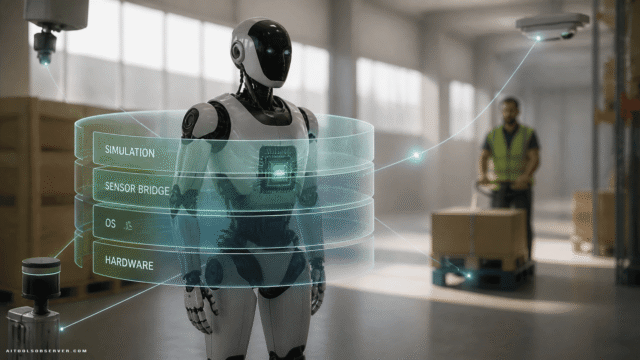
- Isaac OS, an open-source runtime framework for connecting sensors, AI models, control systems, and robot hardware
- Isaac Lab 3.0, now generally available for training robot behaviors with reinforcement learning and physics simulation
- Human 1M Dataset, with human activity recordings and 3D hand-tracking data for robot training
- SimReady Central Library, with more than 2,000 simulation-ready robotics and factory assets
- Reference workflows combining Isaac GROOT, Cosmos world models, and reinforcement learning for synthetic data generation and robotic manipulation
- Agile ONE SN, a reference humanoid platform developed by Agile Robots
This is not just a toolkit refresh. It is Nvidia extending Isaac into a more complete development environment for physical AI and general-purpose robotics.
Why this matters
The hard part of robotics is not only getting a robot to perform one action in a controlled setting. It is getting systems to learn useful behaviors, transfer them from simulation to reality, and handle environments built for humans.
That is why this announcement matters. Nvidia is positioning Isaac as a full-stack platform where developers can work across:
- data collection
- simulation
- reinforcement learning
- synthetic data generation
- runtime integration
- deployment on actual robot hardware
For teams building humanoid systems, manipulation platforms, warehouse robotics, or factory automation, that tighter stack can reduce friction between research and engineering.
Isaac OS looks like a practical bridge layer
Isaac OS may be one of the most important parts of the update, even if it gets less attention than humanoid hardware.
A runtime framework that connects sensors, models, controls, and hardware addresses a persistent robotics problem: many systems work in isolation, but production robots need these parts to operate together with timing, reliability, and maintainability. An open-source runtime also suggests Nvidia wants Isaac to be more than a simulation brand. It wants to sit in the operational path.
For developers, that means Isaac is moving closer to an end-to-end robotics software layer rather than only a training or prototyping environment.
Isaac Lab 3.0 pushes the training side forward
Isaac Lab 3.0 is now generally available and focused on reinforcement learning plus physics-based simulation. That matters because robotic capability often depends on how quickly teams can iterate on behavior training before they touch expensive or fragile hardware.
In practice, this helps with tasks such as:
- grasping and manipulation
- locomotion and balance
- multi-step task execution
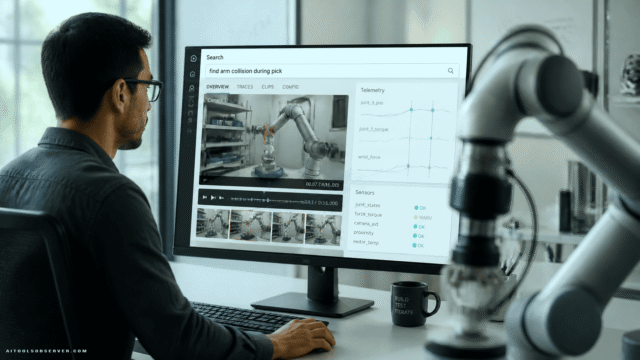
- controller tuning in simulation before field testing
The value is speed, but also repeatability. If teams can train more behaviors in simulation with stronger tooling, they can test more edge cases before deployment.
The Human 1M Dataset targets a specific pain point
Humanoid and dexterous manipulation systems need human-centered data. Training robots to operate in human spaces is difficult without examples of how people move, handle objects, and coordinate hands.
The Human 1M Dataset is relevant because it appears to provide two important ingredients:
- human activity recordings
- 3D hand-tracking information
That combination could be useful for imitation learning, manipulation research, and tasks where hand motion matters more than simple arm trajectories. For teams working on humanoids or robotic hands, datasets like this can shorten the path from concept to testable behavior in physical AI.
Agile ONE SN gives developers a concrete reference platform
The reference humanoid from Agile Robots adds a hardware anchor to the broader software update.
Based on the available description, Agile ONE SN is built for researchers and developers rather than mass-market deployment. It incorporates Nvidia’s Isaac GROOT foundation model and Jetson Thor computing system, and is designed to combine hardware, simulation, and AI training tools in a single platform.
Its listed characteristics suggest a system intended for dexterous humanoid research:
- 1.4 meters tall
- 40 kilograms
- 31 degrees of freedom
- two five-finger robotic hands
- 20 degrees of freedom per hand
- tactile sensing
- force control
That specification matters less as a headline number and more as a signal of intended use. This is the kind of platform suited to manipulation experiments, skill learning, and embodied AI research where hand capability is central.
Nvidia is also reinforcing the synthetic data workflow
Another notable part of the announcement is the release of reference workflows that combine Isaac GROOT, Cosmos world models, and reinforcement learning.
The practical idea here is straightforward: if real-world robotic data is expensive, slow, or unsafe to collect at scale, synthetic data and simulated experience become more important. A workflow that links world modeling with robot training can help teams create more varied training scenarios before real-world validation.
This is especially relevant for:
- rare edge cases
- dangerous interactions
- long-tail manipulation scenarios
- environments that are costly to recreate physically
The tradeoff, as always, is transfer quality. Better synthetic workflows can accelerate development, but they still depend on how well simulated behavior maps onto physical reality.
European robotics firms are building on the stack
The broader significance of the update becomes clearer in the ecosystem examples. Several European robotics companies are integrating Nvidia’s software and compute into their own products and development environments.
Examples in the provided context include:
- ABB Robotics, integrating Omniverse libraries with RobotStudio HyperReality
- Kuka, using Omniverse via Visual Components FactoryLens
- Sereact, using Isaac GROOT and Cosmos Transfer for robotic manipulation
- Neura Robotics, using Isaac Sim and Isaac Lab to train its Neuron AI foundation model
- Humanoid and Hexagon Robotics, developing perception, control, and simulation capabilities on Nvidia platforms
This matters because platform claims become more credible when they show up across different industrial contexts: simulation, manipulation, perception, factory software, and humanoid development.
What this means for AI tool buyers and robotics teams
For readers tracking AI tools, this is less about one new model and more about stack consolidation.
Nvidia is making a strong case that physical AI development will depend on integrated tooling across data, simulation, model training, and runtime systems. If you are evaluating robotics platforms, the question is no longer just whether a vendor offers simulation or inference hardware. It is whether the pieces work together well enough to support continuous iteration.
That changes the evaluation criteria. Teams should look at:
- how easily simulation connects to real robot deployment
- whether reinforcement learning workflows are production-friendly
- what datasets and synthetic data tools are included
- how much of the stack is open versus locked into specific infrastructure
- whether the ecosystem already supports the robot types and use cases you care about
The bigger signal
Nvidia’s update suggests the robotics market is moving toward foundation models-assisted development, heavier use of simulation, and tighter links between training environments and embodied systems.
The most useful way to read this announcement is not as proof that general-purpose robotics is solved. It is a sign that the tooling around physical AI is becoming more structured, more interoperable, and more targeted at deployment rather than isolated demos.
For builders, the practical takeaway is simple: if your robotics workflow still treats data, simulation, learning, and hardware integration as separate projects, platforms like Isaac are increasingly designed to compress that gap.




Comments (0) No comments yet
Want to join this discussion? Login or Register.
No comments yet. Be the first to share your thoughts!