


What’s Actually Launching
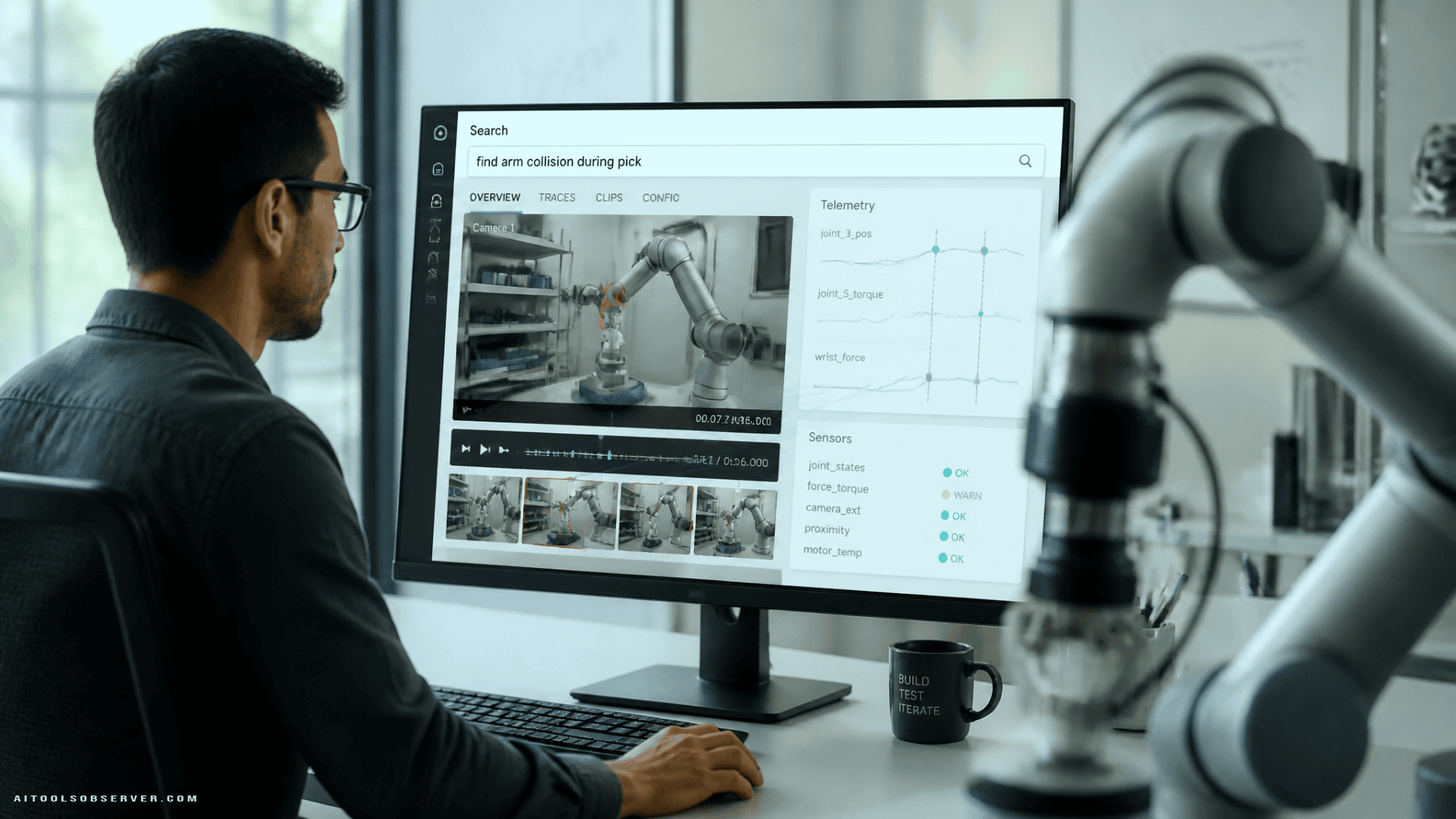
Foxglove Semantic Search lets developers describe a behavior or scenario in plain language and retrieve matching multimodal segments from large volumes of unlabeled robot data. The results aren’t just video clips — each match stays connected to the synchronized sensor data, telemetry, logs, and system signals recorded around that moment.
That context matters. Finding an event on camera is only useful if you can immediately understand what the rest of the robot was doing when it happened.
Why NVIDIA Cosmos, Not a General-Purpose Model
This is where the technical choice becomes practically important. General-purpose image-text models are trained on internet data — photos, captions, web content. They lose accuracy quickly when applied to complex manipulation tasks, driving scenes, or temporal action sequences.
NVIDIA Cosmos is a video-text embedding model trained specifically on robotics, driving, and ego-centric human action data. That domain specificity translates directly to better retrieval accuracy on the kinds of scenarios physical AI teams actually care about. Using a general model here would be a meaningful step backward in precision.
The Infrastructure Angle
One detail worth noting for teams evaluating this: Foxglove handles indexing and inference infrastructure with zero operational overhead on the customer side. There’s nothing to deploy or maintain.
When combined with Foxglove’s Bring-Your-Own-Storage (BYOS) architecture, semantic search indexes and queries raw logs stored directly in your own cloud storage. No unnecessary data duplication, no forced migration.
A Broader Set of Capabilities
Semantic search is the headline, but Foxglove announced several connected capabilities that together form a more complete workflow:
- Agent Sidebar — coordinates work across the platform, letting developers find data, create visualizations, investigate failures, compare runs, and curate datasets from a single interface.
- Comparison Mode — synchronizes two or more runs side by side, making it easier to spot where behavior diverged across model versions, software releases, or robot configurations. Useful for validating releases and tracking drift.
- Remote Access — streams every topic from a deployed robot directly to the browser in real time. Camera, lidar, telemetry, and logs arrive at low latency in the same environment teams use for recorded data analysis, which means field issues can be diagnosed without sending anyone onsite.
Who This Is For
This is aimed squarely at robotics and autonomous systems teams operating at scale — companies moving from a handful of robots to production fleets, where the volume of data generated outpaces any manual review process.
The value compounds as fleets grow. Rare edge cases and failure modes become harder to find, but they’re also the events that drive the most meaningful improvements. Faster retrieval means faster iteration in physical AI.
The Practical Takeaway
If your team is spending significant time hunting through unlabeled logs to find specific behaviors, this combination of domain-specific semantic search and synchronized multimodal context is worth a close look. The NVIDIA Cosmos foundation addresses a real limitation of general-purpose models in physical AI contexts, and the managed infrastructure removes a common barrier to adoption.
The underlying architecture — time-synchronized data from cameras, lidar, radar, transforms, telemetry, and logs treated as a single connected record — is what makes the agentic workflows here actually reliable. That grounding is what separates useful AI-assisted debugging from tools that produce plausible-sounding but unverifiable answers.
More details are available at foxglove.dev.







Comments (0) No comments yet
Want to join this discussion? Login or Register.
No comments yet. Be the first to share your thoughts!