


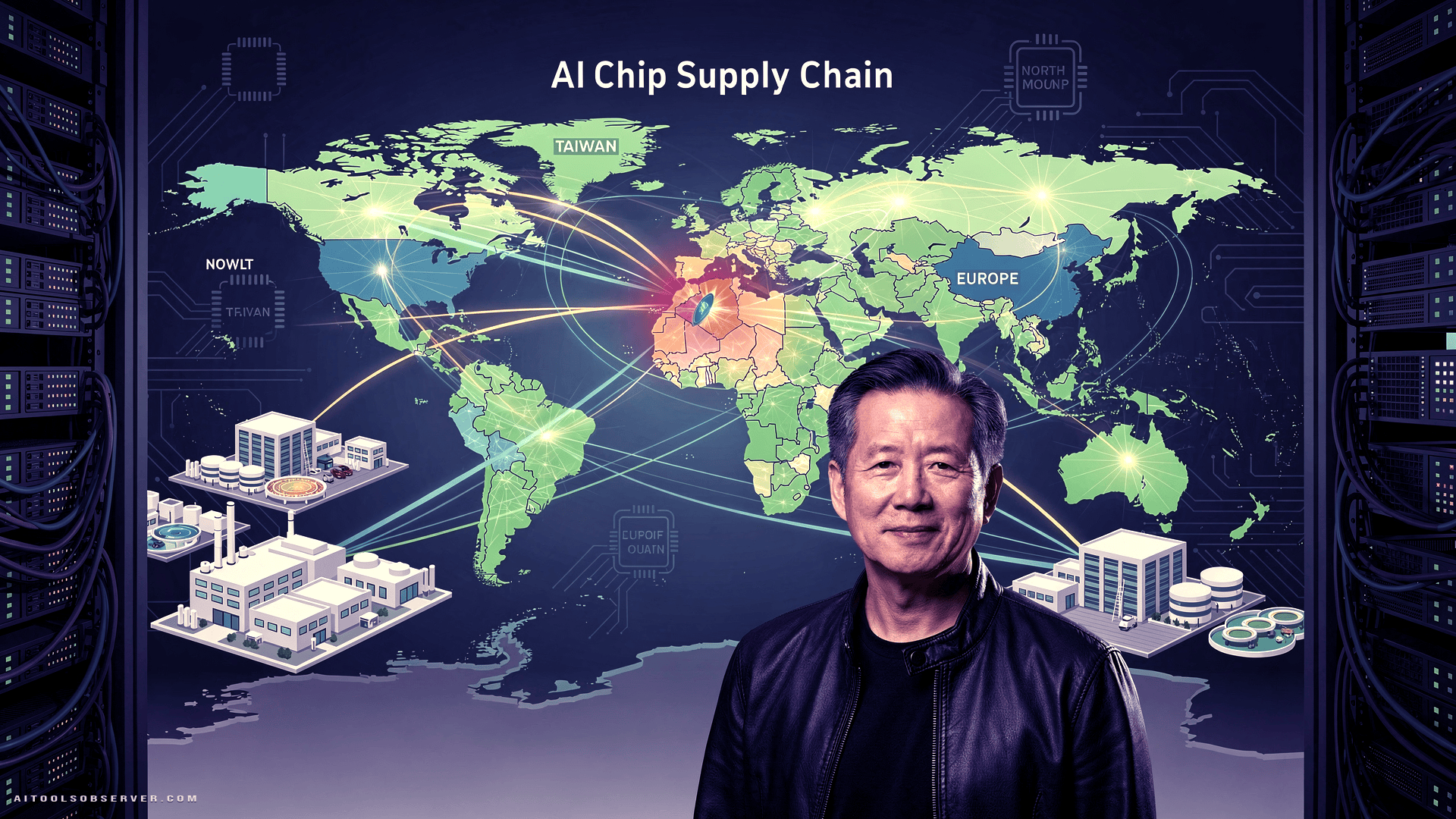
From $15B to $150B: The Numbers Tell the Story

Five years ago, Nvidia was spending roughly $10–15 billion a year in Taiwan. Now it’s at $100 billion and climbing toward $150 billion. That’s a 10x increase in half a decade, tracking almost perfectly with the explosion in AI infrastructure demand.
Tech giants collectively plan to spend $750 billion on AI infrastructure this year alone, with a significant chunk going toward data center chips. Nvidia, as the world’s most valuable company — the first ever to hit a $5 trillion market cap — needs to keep pace with that demand or risk losing its lead.
Taiwan isn’t just convenient. It’s structurally essential.
Why Taiwan and Not Just the US

Nvidia did make a symbolic move last April, producing AI chips on US soil for the first time. Huang called it a milestone. Trump called it a win. But the reality was messier.
Even with US-based chip production, Nvidia still had to ship chips to Taiwan for advanced packaging — a critical step that US factories simply can’t replicate yet. TSMC’s American facilities don’t have that capability. The Taiwan ecosystem does, and it comes bundled with proximity to Foxconn, Wistron, Quanta Computer, and a dense web of partners that make AI server buildouts actually happen.
For Nvidia’s next-generation AI system, Vera Rubin — which Huang describes as a “generational leap” and the start of “the greatest infrastructure buildout in history” — supply chain constraints are already a known risk. The Taiwan HQ looks less like a headquarters and more like a supply chain insurance policy.
The Trump Tension Nobody’s Officially Talking About
Here’s where it gets interesting. Trump has been loudly pushing for US-first AI manufacturing. Nvidia committed $500 billion to US data centers. Huang attended a Mar-a-Lago dinner at a $1 million ticket price. The relationship has been carefully managed.
But $150 billion a year flowing into Taiwan is hard to square with “America First” AI policy. Nvidia hasn’t explained how these two commitments coexist. Trump hasn’t commented on the Taiwan announcement. The silence from both sides is doing a lot of work.
Huang, for his part, has been increasingly candid about where Trump’s trade tactics are falling short. His export curbs on chips sold to China have, by Huang’s own assessment, “already largely backfired.” China stopped buying Nvidia chips — not because of the fee, but because the routing requirement through the US raised fears of tampering. Nvidia has now largely conceded that market to Huawei.
“Conceding an entire market the size of China probably don’t make a lot of strategic sense,” Huang said plainly.
The Tariff Cloud on the Horizon

Semiconductors used in data centers are currently exempt from Trump’s tariffs. That exemption may not last.
Investigations concluding in July could trigger “significant” additional tariffs on imported chips, aimed at pushing domestic manufacturing. The US currently produces about 10 percent of the chips it needs — a number Trump has called dangerously low. Trade representative Jamieson Greer has confirmed that reshoring the semiconductor supply chain remains a core goal, even if no new levies are imminent.
The implication for Nvidia: its US investment commitments may be the shield that keeps it tariff-exempt. Huang appears to be playing both sides of this equation with precision — enough US investment to stay in Trump’s good graces, enough Taiwan investment to actually keep the chips flowing.
Taiwan’s Position Isn’t Going Anywhere Soon

Taiwan currently produces over 90 percent of the world’s most advanced semiconductor chips. That concentration makes global supply chains nervous, and there’s a long-term expectation that manufacturing will diversify as more nations build domestic capacity.
But Huang isn’t betting on “long-term.” He’s betting on now — and the next five years. He was born in Taiwan before emigrating to the US at age 9, and while that’s biographical context rather than business logic, his conviction about Taiwan’s staying power reads as both personal and calculated.
Trump has sent mixed signals on Taiwan’s geopolitical status, at one point suggesting it’s up to Xi whether China invades. Taiwan, for its part, rejected demands to shift 50 percent of chip production to the US. The political situation is volatile. The manufacturing reality is not.
What This Means If You’re Watching the AI Tools Space

For anyone tracking AI tools and infrastructure, this announcement is a signal worth internalizing. The chips powering every AI model, every inference call, every agentic workflow — they’re being built, packaged, and shipped through an ecosystem that Nvidia just doubled down on.
Supply chain constraints on Vera Rubin and future systems will directly affect AI tool availability, pricing, and capability timelines. When Huang says demand is accelerating “at extraordinary speed,” he’s describing the same pressure that shapes which AI tools get compute access and which ones wait in line.










Comments (0) No comments yet
Want to join this discussion? Login or Register.
No comments yet. Be the first to share your thoughts!