


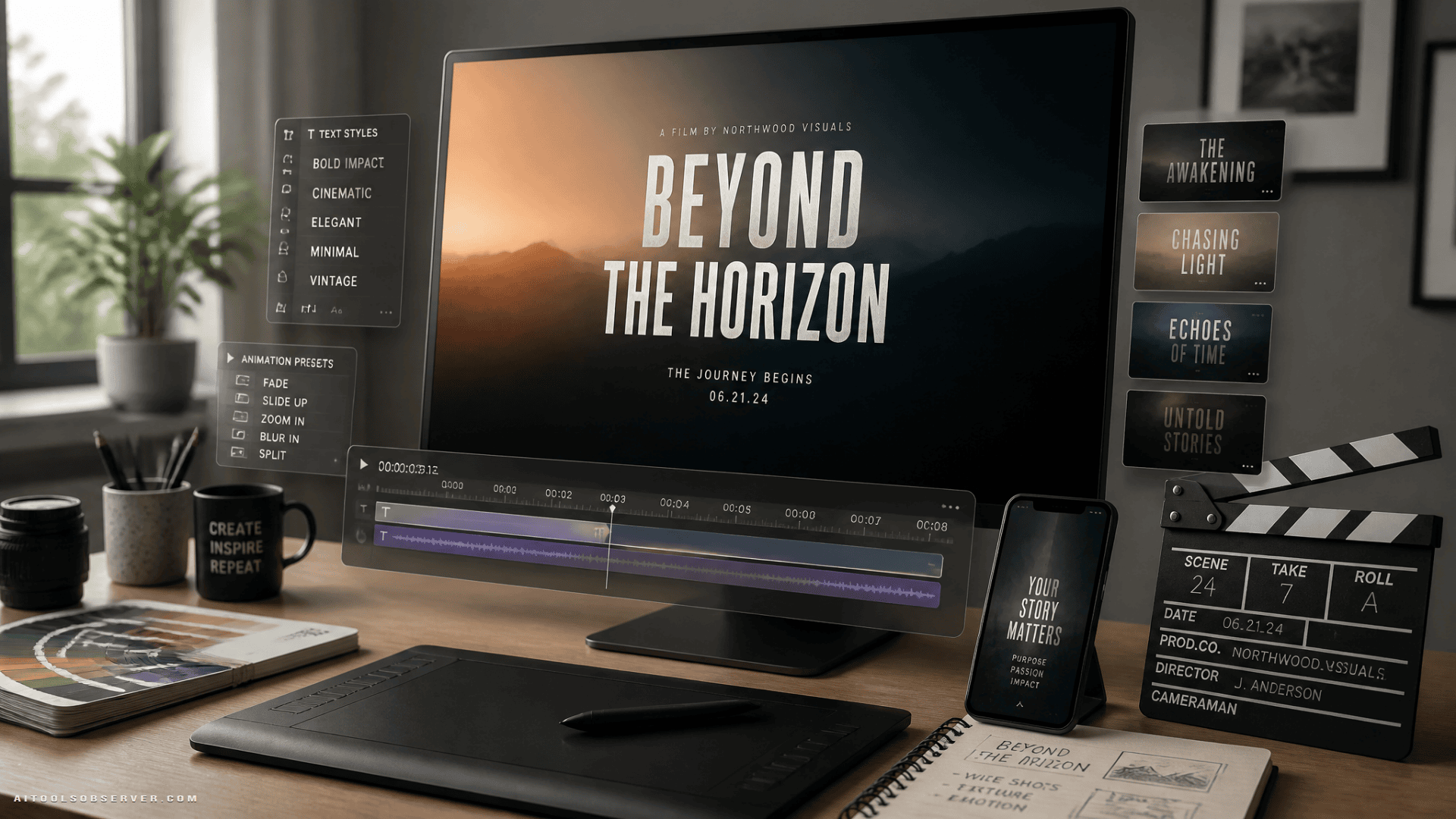
1. InVideo Agent
The core problem with most title card workflows is that you build the card separately and then spend extra time making it match the rest of the video. InVideo Agent removes that second step.
Because title cards generated inside a project share the same persistent context engine as the rest of the video, the visual style, characters, and tone are already consistent. The platform routes generation through 200+ integrated models — including Veo 3.1, Sora 2, Kling 3.0, Runway, Recraft, and GPT Image 2.0 — and Camera Controls let you add a deliberate move like a slow reveal or environmental push directly into the generation pass.
Best for: A title card that already matches the rest of your project without a separate matching pass.
Where it falls short: It’s not a dedicated typography tool. If you need to hand-tune letterform details, you’ll still want something like Kittl for that pass.
Pricing: Plans start at $17/month, with team and enterprise options available.
2. Canva
Canva‘s Magic Design generates a fully editable design — not a flat image — from a text description in seconds. With over 260 million users and a massive template and stock library, it’s likely the single fastest realistic path from a blank page to a polished, cinematic-looking title card that you can still adjust afterward.
The key word is editable. You’re not locked into a render. You can tweak fonts, swap colors, and reposition elements without starting over.
Best for: The fastest overall path to a polished, editable title card.
Where it falls short: Premium templates and assets carry a watermark on the free tier, and the deepest AI features sit behind Pro or Business plans.
Pricing: Free plan available; Pro around $13–15/month.
3. Renderforest
Renderforest’s AI intro maker generates a title card or intro directly from a text prompt or chosen style. For creators who’d rather start from something built than a blank generation, there’s a catalog of over 50,000 existing templates to work from.
It’s particularly strong for logo reveals and channel branding — situations where you need a repeatable, professional-looking intro without a motion design background.
Best for: Fast, AI-generated intros and title cards for logo reveals or channel branding.
Where it falls short: The free plan caps output at 360p with a watermark.
Pricing: Free tier available; Lite plan from $9.99/month.
4. Panzoid
Panzoid takes a different approach. Instead of generating from a prompt, it lets you reshape an existing community template in a 3D scene editor. In practice, that’s fast — even if the interface looks dated compared to newer competitors.
For a YouTube channel or small project that needs a completely free, customizable title card, it’s hard to beat on price.
Best for: A completely free, customizable title card for YouTube or small projects.
Where it falls short: There’s a real learning curve for first-time users. The speed advantage kicks in once you understand the interface, not before.
Pricing: Free version available with a watermark; Starter plan from $1.99/month.
5. Kittl
Typography is usually the most time-consuming part of a title card. Kittl’s AI text-to-vector engine generates distinctive title typography directly from a description, skipping the manual font-pairing and layout work that most designers spend the most time on.
The result is fast, professional-looking type without needing a design background to get there.
Best for: Fast, professional-looking typography for a title card without design experience.
Where it falls short: Its AI video feature is generation-only with no timeline editor. Any animation still requires a separate tool downstream.
Pricing: Free tier available; Pro plan from $12/month.
6. CapCut
For short-form or mobile-first content, CapCut’s large template library and word-by-word animated text timing get a title card assembled and exported directly from a phone faster than any desktop compositing workflow.
If your content lives on TikTok, Instagram Reels, or YouTube Shorts, this is the most practical option on the list.
Best for: The fastest title card specifically for short-form or mobile-first content.
Where it falls short: It’s built for speed and templates rather than fully custom, frame-exact typography.
Pricing: Free plan available; Pro plan around $20/month.
For related workflows, see video editing and post-production.
7. Kapwing
Kapwing’s 100+ preset caption and title styles cover font, color, drop shadow, and animation timing in a single selection. Most of the styling decisions are already made — you’re adjusting, not building from scratch.
That’s where the speed comes from. It’s a strong option for teams producing consistent content at volume.
Best for: Quick, on-brand title styling pulled from a large preset library.
Where it falls short: It’s built around routine content production rather than the fully custom compositing a distinctive feature-film title card might need.
Pricing: Free tier available; Pro plan from $16/month.
8. Recraft
Recraft’s AI vector generation produces consistent brand graphics quickly — recurring logo treatments, supporting icons, chapter cards — that match a title card’s established color palette and line weight without manual style-matching.
It’s most useful as a supporting tool in a broader title card system rather than the primary card generator.
Best for: Fast, brand-consistent vector graphics that support a title card’s broader visual system.
Where it falls short: It’s an image and vector tool, not an animation platform. Motion still needs to be added downstream.
Pricing: Free tier available; paid plans from roughly $10/month.
9. Kaiber
Kaiber’s speed advantage is conditional — but once it kicks in, it’s significant. After a Custom Model is trained on a specific visual style, generating new stylistically matched title cards becomes fast without re-establishing the look manually each time.
For a series, a recurring show, or a brand with a defined visual identity, that upfront training investment pays off quickly.
Best for: Quickly generating additional stylized title cards that already match a previously trained visual identity.
Where it falls short: The initial Custom Models training step takes real setup before the speed advantage applies.
Pricing: Explorer plan from $5/month.
10. Leonardo AI
Leonardo AI’s character and style reference tools generate consistent concept art and key art quickly, giving you a fast visual target for a title card’s mood and palette before any typography or motion work begins.
Think of it as the fastest way to answer the question “what should this title card feel like?” before you commit to building it.
Best for: Quickly establishing a title card’s visual direction through concept art before building the final version.
Where it falls short: It’s a stills tool. It feeds the concept stage rather than producing the finished, animated title card itself.
Pricing: Free tier with 150 daily tokens; paid plans from $12/month.
Which Tool Should You Actually Use?
The right answer depends on where you are in the workflow and what you’re optimizing for.
| Situation | Best Tool |
|---|---|
| Title card that matches the rest of your video automatically | InVideo Agent |
| Fastest path to a polished, editable result | Canva |
| AI-generated intro from a prompt or style | Renderforest |
| Free, customizable 3D title card | Panzoid |
| Distinctive typography without design skills | Kittl |
| Short-form or mobile-first content | CapCut |
| On-brand styling from a large preset library | Kapwing |
| Brand-consistent supporting graphics | Recraft |
| More cards in an already-trained visual style | Kaiber |
| Concept art to establish visual direction first | Leonardo AI |
The Practical Takeaway
No single tool wins across every use case here, and that’s actually useful information. If you’re producing a single video, Canva or InVideo Agent will get you to a finished title card faster than anything else on this list. If you’re running a series with a defined visual identity, the upfront investment in Kaiber’s Custom Models or Kittl’s typography system starts paying back quickly.
The tools that tend to disappoint are the ones people pick for the wrong stage. Recraft and Leonardo AI are fast and genuinely good — but they’re concept and asset tools, not finished-card tools. Use them to establish direction, then hand off to something with a timeline.
Match the tool to the moment in the workflow, and most of these options are faster than they look.
For broader context on AI design tools, see the related comparison.




Comments (0) No comments yet
Want to join this discussion? Login or Register.
No comments yet. Be the first to share your thoughts!