


What the Research Actually Built
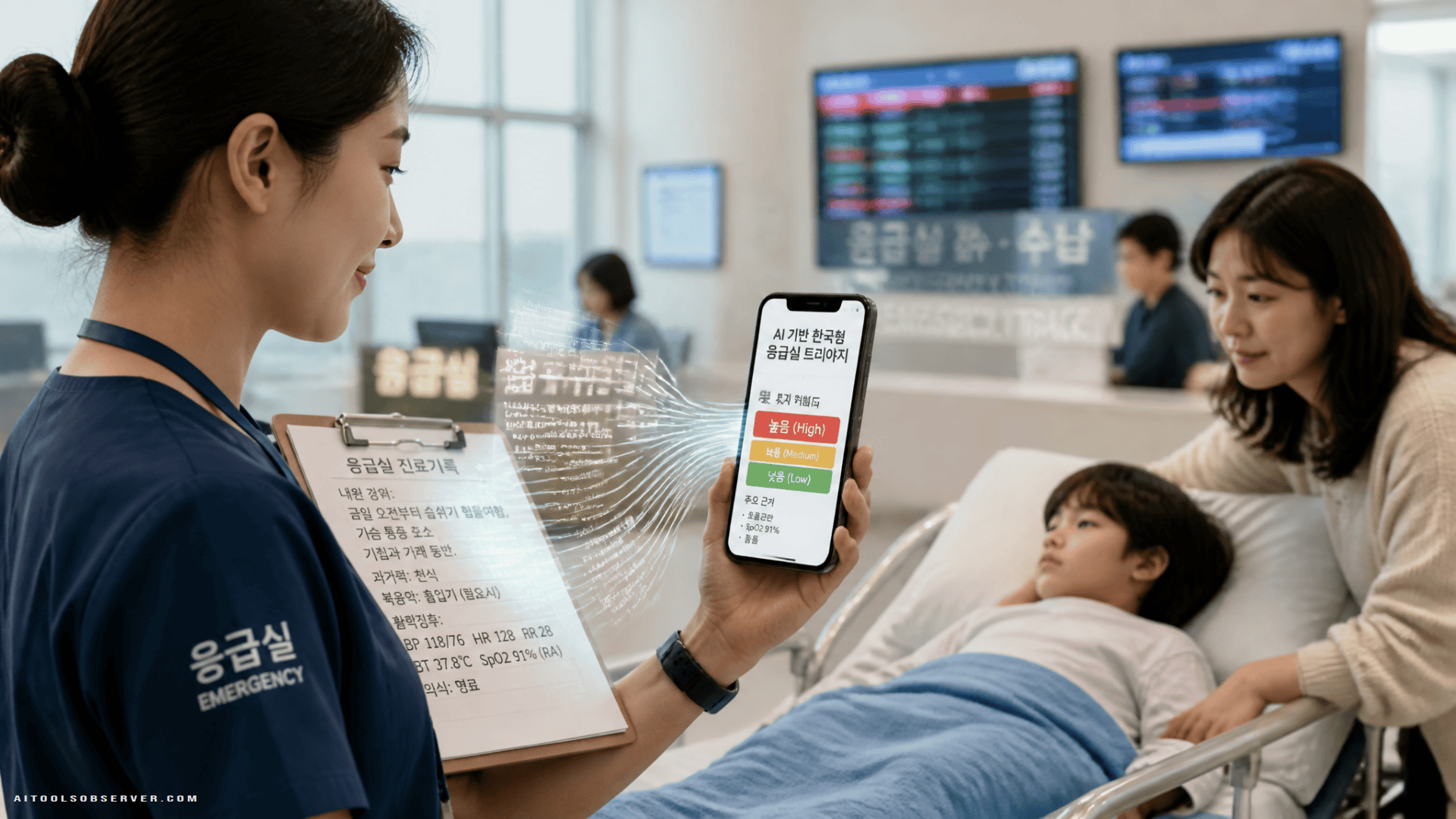
The team developed a triage AI application trained on electronic medical records from approximately 87,759 pediatric emergency department visits. The model is built on Korean Medical-BERT, a language model fine-tuned for clinical Korean text.
The key finding: it outperformed the Korean Triage and Acuity Scale (KTAS) — the standard structured scoring system currently used in Korean emergency departments — in predicting which patients required emergency treatment.
That’s not a small claim. KTAS is a validated, widely used tool. Beating it with a language model trained on free-text clinical notes signals something meaningful about where AI-assisted triage is heading.
Why Medical-BERT Changes the Equation
Traditional triage scales work by scoring structured inputs — vital signs, chief complaint categories, observable symptoms. They’re fast and consistent, but they can miss nuance buried in clinical notes.
Medical-BERT-style models read unstructured text. That means they can extract signal from how a nurse or physician actually described a patient’s presentation, not just which checkbox was ticked.
This matters because:
- Free-text notes often contain early warning signals that don’t fit neatly into structured fields
- Language patterns in clinical documentation can reflect urgency before lab results or imaging are available
- Regional language models like Korean Medical-BERT are trained on domain-specific vocabulary, which improves accuracy compared to general-purpose models applied to medical text
The Smartphone App Angle
The researchers aren’t stopping at a published model. They’re developing the technology into a smartphone application, with multi-centre validation studies and additional post-pandemic testing underway.
That deployment choice matters. A smartphone-based clinical decision support tool means:
- Frontline access without infrastructure dependency — useful in hospitals with limited IT integration
- Faster adoption cycles compared to full EHR system integrations
- Scalability across facilities facing staffing shortages or high patient volumes
Emergency departments dealing with overcrowding and pediatric care shortages stand to benefit most. The app doesn’t replace clinical judgment — it gives clinicians a faster, data-informed second opinion at the point of triage.
The Broader Use Case for Clinical Triage AI
This project reflects a pattern emerging across emergency medicine and health technology: validated medical language models are becoming the foundation for scalable, region-specific decision-support tools.
A few implications worth tracking:
For emergency medicine teams, triage AI introduces more precise patient prioritization. That can reduce bottlenecks and improve outcomes in high-pressure environments where every minute counts.
For pediatric healthcare specifically, child-focused predictive tools support specialized care pathways. Pediatric presentations are often harder to triage accurately — children communicate symptoms differently, and physiological baselines vary significantly by age.
For health technology builders, this validates a commercial model: take a well-curated regional clinical dataset, fine-tune a domain-specific language model, validate it against an existing standard, and build toward a mobile-first deployment. The Korean Medical-BERT approach is a replicable template.
What Still Needs to Happen
The research is promising, but it’s not ready for broad clinical deployment yet. Multi-centre validation is still in progress, and post-pandemic testing is ongoing — important because emergency presentation patterns shifted significantly during COVID-19 and haven’t fully normalized.
Regulatory approval pathways for clinical AI tools also vary significantly by country, which affects how quickly a validated model can become a deployed product.
The honest read: this is a strong proof of concept with a credible development roadmap, not a finished product.
Workflows built on electronic medical records also need careful evaluation during validation and deployment.
The Practical Takeaway
If you’re watching the clinical AI space, this case study illustrates exactly where language models add value that structured scoring systems can’t easily replicate — extracting predictive signal from unstructured clinical text, at the point of care, before diagnostic results are in.
The pediatric ER is one of the most demanding environments to get right. The fact that a Medical-BERT-based model is outperforming an established triage scale in that context is a signal worth taking seriously — for healthcare providers evaluating AI decision support tools, and for anyone building in the clinical AI space.



Comments (0) No comments yet
Want to join this discussion? Login or Register.
No comments yet. Be the first to share your thoughts!