


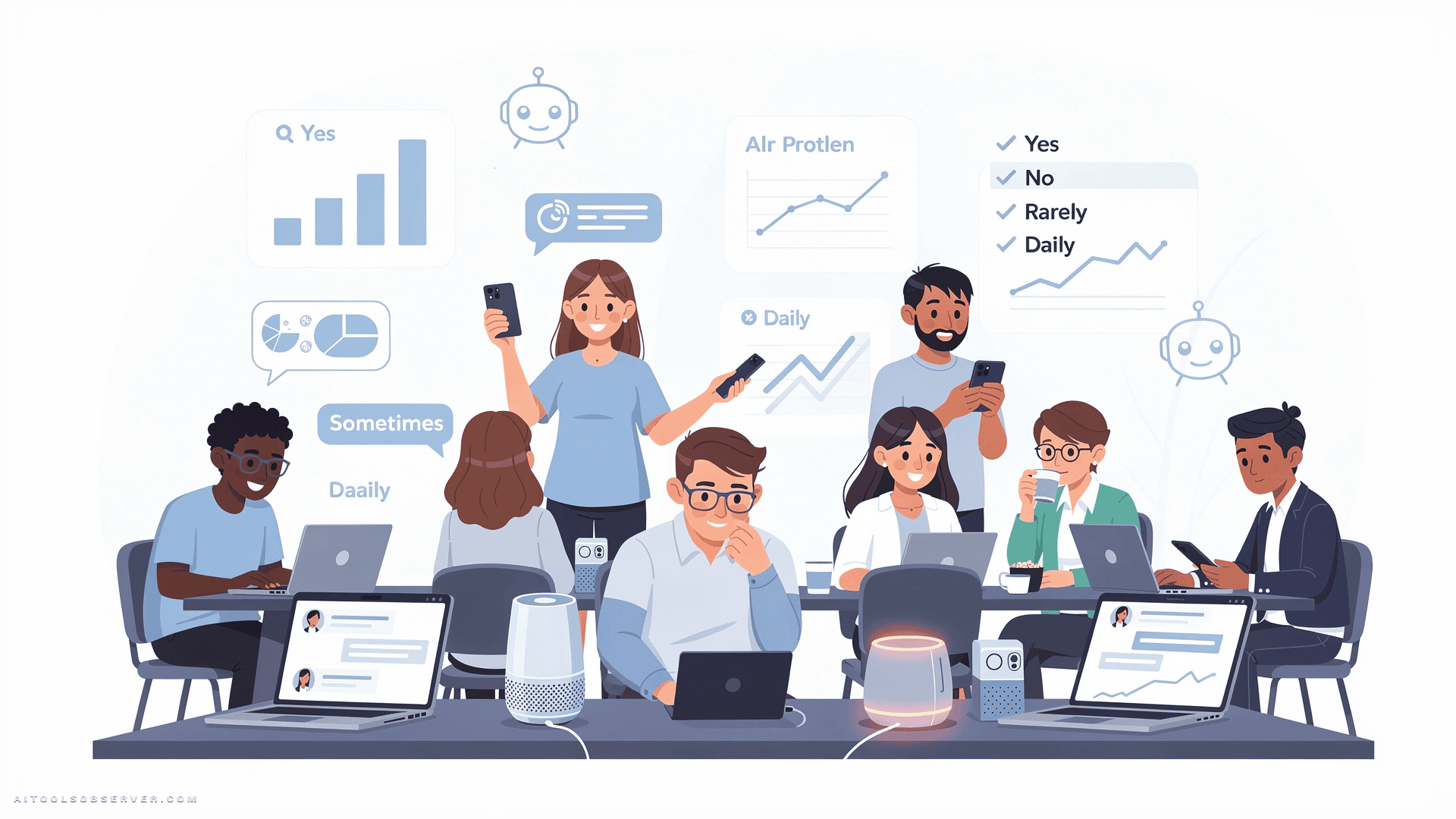
Chatbot Adoption Has Crossed a Meaningful Threshold

The headline figure is unambiguous: roughly half of U.S. adults now report using AI chatbots. That is a substantial increase from approximately one-third in the summer of 2024. The shift is not marginal — it represents tens of millions of additional users entering the category within roughly 18 months.
Daily usage is also notable. About 24% of U.S. adults use chatbots on a daily basis — 4% almost constantly, 12% several times a day, and 8% approximately once a day. Another 25% use them several times a week or less. The remaining 51% do not use AI chatbots at all, which means the non-user population remains the single largest segment, but it is shrinking.
What People Actually Use Chatbots For
The dominant use case is information search. About four-in-ten U.S. adults report using chatbots to search for information — a function that places these tools in direct competition with traditional search engines. Work-related tasks follow closely: 38% of employed adults use chatbots for professional work.
Creative and media-adjacent uses trail significantly. Around one-in-five use chatbots for image or video creation and editing. Thirteen percent use them for news consumption. At the more personal end of the spectrum, one-in-ten report using chatbots for emotional support, and a smaller share use them for companionship — a use pattern that warrants separate attention as the category matures.
ChatGPT Dominates, But the Field Is Widening
ChatGPT remains the clear market leader. Forty-four percent of U.S. adults report using it — up from 34% in 2025 and more than double the share recorded when Pew first asked the question in 2023. Gemini holds second position at roughly one-quarter of adults. Copilot and Meta AI follow, with Grok, Claude, and Character.ai each capturing smaller shares.
The age gap is sharp and operationally significant. Adults under 50 are approximately twice as likely as those 50 and older to report using ChatGPT (57% vs. 28%). For product teams and marketers, this bifurcation defines two distinct audiences with different onboarding needs and trust baselines.
Smart Devices: Broad Ownership, Uneven AI Awareness

AI-enabled hardware tells a different adoption story. Smartwatches are the most widely owned category — about 37% of U.S. adults report having one. Smart speakers (e.g., Amazon Echo, Apple HomePod) are present in roughly 35% of households.
Penetration drops sharply for more specialized devices. Smart doorbells with AI features are owned by about 18% of adults. Robot vacuums and smart thermostats with AI capabilities each sit at roughly 10–13%. These numbers reflect both price sensitivity and the fact that many consumers may own these devices without actively associating them with AI — a perception gap that matters for how the industry communicates value.
AI Search Summaries: Exposure Without Intention
Six-in-ten U.S. adults report having read AI-generated summaries at the top of search engine results. This is a particularly significant data point because it captures passive exposure — users encountering AI outputs without necessarily choosing to engage with an AI tool directly.
Thirty percent say they have not seen such summaries, and 10% are unsure. The implication is that AI search integration has already reached a majority of the adult population, largely through the default behavior of major search engines. Adoption here is less a deliberate choice and more an ambient condition of using the web in 2026.
Public Sentiment: Skepticism Is the Dominant Register
The productivity and creativity numbers are modestly positive. Three-in-ten Americans say chatbots help their productivity; a similar share say they help them stay informed. About one-in-five report a positive effect on creativity. In each case, the share reporting harm is substantially smaller — around 5% for productivity and information, 11% for creativity.
But the broader societal picture is considerably more cautious.
Society and Personal Impact
Forty percent of U.S. adults expect AI to have a negative impact on society over the next 20 years. Only 16% anticipate a positive impact. Thirty-one percent expect an equal mix of positive and negative effects, and 13% are unsure. The pessimism is less pronounced but still present at the personal level: 31% expect a negative personal impact, roughly one-quarter expect a positive one, and about three-in-ten anticipate a mixed outcome.
These figures do not describe a population that has rejected AI — they describe one that is using it with open eyes and genuine reservations.
Pace of Development
Sixty-three percent of Americans believe AI is advancing too quickly. Only 19% say the pace is about right, and 2% say it is too slow. This is not a fringe position — it is the majority view, and it has direct implications for how AI companies communicate roadmaps, safety practices, and deployment decisions to the public.
Data Security
Seventy-one percent of U.S. adults predict that AI will make their personal information less secure. Just 3% expect improved security. Ten percent believe it will make little difference. This level of concern — held by nearly three-quarters of the adult population — is a structural challenge for any AI product that handles personal data, regardless of its actual security architecture.
Institutional Trust Has Not Recovered
Confidence in oversight institutions remains low and has declined slightly. Sixty-seven percent of Americans express little to no confidence in the U.S. government to regulate AI effectively, up from 62% in 2024. About six-in-ten are not confident in U.S. companies to develop and use AI responsibly.
Partisan differences exist but should not be overstated. Seventy-four percent of Democrats report low confidence in government regulation, compared with 61% of Republicans. On corporate responsibility, 65% of Democrats and 53% of Republicans express low confidence. Skepticism of both government and industry is broadly distributed across the political spectrum — it is not a partisan phenomenon, even if the intensity varies.
The Age Paradox
Younger Americans are the heaviest users of AI tools and simultaneously among the most skeptical of AI’s societal effects. Adults under 30 are more likely than those 30 and older to predict that AI will have a negative impact on both society and themselves personally. This is not a contradiction — it reflects a generation that is deeply embedded in AI-mediated environments and therefore more attuned to its costs and risks.
The under-50 cohort drives adoption metrics across nearly every category. The over-50 cohort represents the largest untapped user base and the most significant barrier to further mainstream penetration.
The Gender Gap
Pew’s data identifies a measurable gender gap in AI adoption and attitudes. While the survey does not provide a single summary statistic here, the gap is consistent with prior research showing that men are more likely to be early adopters of AI tools and to express more favorable views of AI’s potential. This gap has implications for product design, marketing, and the diversity of use cases that get prioritized in AI development.
What the Non-Users Are Telling Us
Fifty-one percent of U.S. adults do not use AI chatbots. Understanding why is as strategically important as understanding the adopters. Pew’s framing of this question — “Why don’t people use chatbots?” — points to barriers that likely include lack of perceived relevance, distrust, complexity, and privacy concerns. The data on data security anxiety (71% expecting worse outcomes) and institutional distrust (67% skeptical of government regulation) suggests that non-adoption is often a reasoned position rather than simple ignorance.
For AI tool developers and platforms, this is the harder problem: not how to improve features for existing users, but how to address the legitimate concerns of a majority that has so far chosen to stay out.
Closing Observation
The Pew 2026 survey does not describe an AI revolution that has swept through American life uniformly. It describes a technology that has achieved genuine mass adoption in specific use cases — information search, work tasks, creative assistance — while generating widespread anxiety about pace, data security, and institutional accountability.
The most precise takeaway for practitioners and observers: AI adoption and AI skepticism are not opposites. They are coexisting conditions in the same population, often in the same individual. Building tools and platforms that acknowledge this duality — rather than dismissing the skepticism as a communication problem to be solved — is likely the more durable path forward.








Comments (0) No comments yet
Want to join this discussion? Login or Register.
No comments yet. Be the first to share your thoughts!