


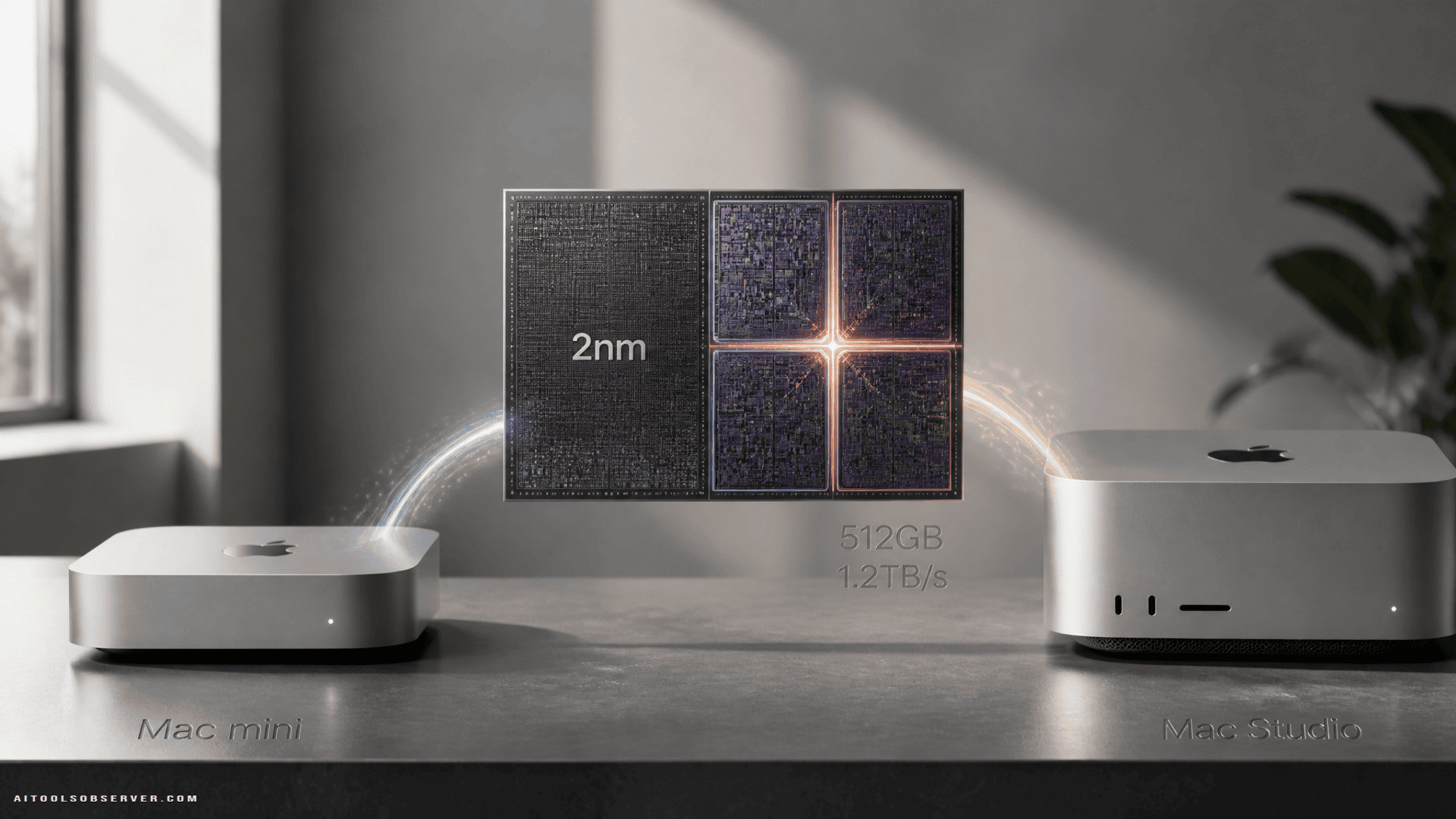
Two Chips, Two Distinct Purposes
The M6 and M5 Ultra are not simply incremental refreshes. They represent two different architectural bets targeting different segments of the market.
M6 is Apple’s first chip built on a 2-nanometer process. It lands in the new Mac mini and is positioned as the right balance of performance, efficiency, and on-device AI for developers, students, and enterprise users running everyday to moderately demanding workloads.
M5 Ultra is Apple’s most powerful chip to date and introduces a quad-die architecture—a first for the M-series. It powers the new Mac Studio and is aimed squarely at professionals and researchers who need maximum compute, massive memory capacity, and the ability to run frontier-scale AI models entirely on device.
M6: What the 2nm Process Actually Changes
The move to 2nm is not just a manufacturing milestone. Greater transistor density translates into a larger, more capable chip within the same thermal envelope.
CPU and Neural Engine
M6 features a 12-core CPU—two more than M5—organized into 2 super cores, 4 performance cores, and 6 efficiency cores. Apple claims up to 1.2x faster multithreaded performance over M5 and up to 2.4x over M1.
The more notable addition for AI workloads is the Dual 16-core Neural Engine. By doubling the Neural Engine configuration and allowing system frameworks to utilize both engines simultaneously, M6 delivers up to 2x the peak neural compute of previous generations. For users running on-device inference pipelines or agentic AI tasks, this is a direct throughput improvement.
GPU and Memory Bandwidth
The 12-core GPU includes a Neural Accelerator in each core, yielding a nearly 30 percent increase in peak GPU compute for AI compared to M5. This matters specifically for prompt processing speed when working with local LLMs.
Unified memory tops out at 32GB, with bandwidth of up to 170GB/s—a 10 percent increase over M5. That bandwidth figure is the practical ceiling for how fast data moves between the CPU, GPU, and Neural Engine, which directly affects inference latency.
M5 Ultra: Quad-Die Architecture and the 512GB Memory Pool
M5 Ultra is structurally different from anything Apple has shipped before. It uses next-generation UltraFusion technology to connect two dual-die M5 Max chips, forming a quad-die SoC with inter-die bandwidth exceeding 4.4TB/s and a connection density more than 6x higher than previous UltraFusion implementations.
The result is a chip that behaves as a single unified processor despite being composed of four dies.
Key Specifications
- CPU: Up to 36 cores (12 super cores, 24 performance cores)
- GPU: Up to 80 cores, each with a Neural Accelerator
- Neural Engine: 32-core
- Unified memory: Up to 512GB
- Memory bandwidth: 1.2TB/s — 50 percent higher than M3 Ultra
Why 512GB of Unified Memory Matters for AI
Most consumer and prosumer hardware forces LLM practitioners to quantize models aggressively or split workloads across multiple machines. With 512GB of unified memory accessible at 1.2TB/s, M5 Ultra can hold models with hundreds of billions of parameters entirely in local memory.
This is directly relevant for researchers using tools like LM Studio, developers fine-tuning foundation models, and teams that need to run complex simulations alongside large AI models—without sending data to an external server.
The 4.5x increase in peak GPU compute for AI compared to M3 Ultra is also significant. Combined with Neural Accelerators embedded in each of the 80 GPU cores, the chip is designed to handle both inference and training-adjacent workloads at a scale that was previously impractical on a desktop machine.
Developer Implications
Apple’s frameworks—Core AI, Core ML, Metal, and Xcode—are updated to take direct advantage of both chips. Developers can:
- Run and fine-tune large AI models locally on Mac
- Use Apple Foundation Models or proprietary models through the same toolchain
- Leverage App Intents to integrate Apple Intelligence features into their applications
The Dual Neural Engine in M6 and the Neural Accelerators in M5 Ultra’s GPU are both exposed through these frameworks, meaning developers do not need to manually orchestrate hardware utilization. The system handles distribution across compute blocks automatically.
Practical Takeaway
The M6 makes capable on-device AI accessible at the Mac mini price point, with a Dual Neural Engine and GPU Neural Accelerators that meaningfully improve inference speed for everyday LLM use. The M5 Ultra removes the memory ceiling that has historically made running large frontier models on a single local machine impractical—512GB of unified memory at 1.2TB/s is a specification that changes what a desktop workstation can do for AI research and development.
For teams evaluating whether to keep AI workloads on-device versus in the cloud, these chips add a credible third option: local infrastructure that scales to serious model sizes, with the privacy and latency advantages that come with it.
















Comments (0) No comments yet
Want to join this discussion? Login or Register.
No comments yet. Be the first to share your thoughts!