



The Real Problem AI Is Solving Here
Most AI coverage focuses on productivity, content creation, or automation. But there’s a quieter use case that doesn’t get enough attention: using AI to compensate for genuine cognitive deficits.
When someone can’t reliably recall whether they attended a family event, forgot to turn off the stove, or can’t remember a colleague’s name — the stakes are personal and immediate. These aren’t inconveniences. They affect relationships, safety, and the ability to hold a job.
The tools being used for this aren’t exotic. Many are already on your phone or in your browser.
Evernote AI Memory
Evernote has long been a journaling and note-taking platform, but its AI Memory function adds a layer that’s genuinely useful for people with recall deficits.
If you’ve been logging your life — events, conversations, interactions — for years, AI Memory lets you query that archive in plain language. Ask what happened at a specific gathering, or who you spoke to at a work event, and the tool surfaces relevant notes fast.
The tradeoff is real: you’re feeding personal memories into a third-party platform. That’s a privacy consideration worth taking seriously, not dismissing.
Claude Projects
Claude Projects lets you upload your own files, documents, and data to create a custom AI assistant that answers questions based on your material — not the general internet.
For someone managing memory loss, this means you can build a personal knowledge base: schedules, names, recurring tasks, family details, medical appointments. Claude then acts as a kind of administrative assistant you can query at any time.
It’s not a replacement for memory. It’s a structured external system that fills in the gaps when recall fails.
Apple Intelligence in Photos
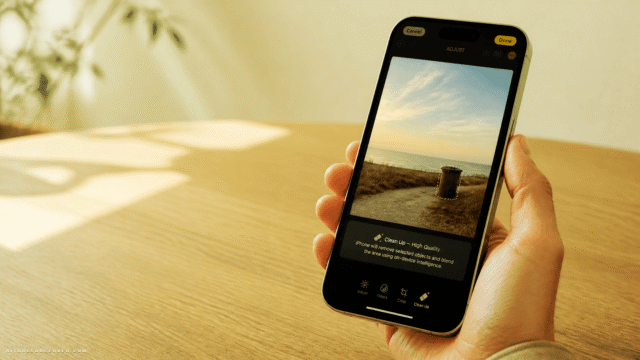
Apple Intelligence‘s built-in AI search in the Photos app lets you search by name, event, location, or even description. For someone trying to verify whether they were present at a gathering — or simply trying to place a face — this is a low-friction, always-available tool.
It works with data already on your device, which makes the privacy profile more manageable than cloud-dependent alternatives.
MemPal (MIT Media Lab)
MemPal is the most specialized tool on this list. Developed at the MIT Media Lab, it uses a wearable camera worn around the neck to observe and record the user’s environment in real time.
Using a multimodal large language model, MemPal generates an automated text diary of the user’s day — actions, conversations, objects. Users can ask questions like “Where did I put my keys?” or receive proactive reminders like “Did you turn off the stove?”
Early research from the MIT Media Lab appears to show improved object-finding performance and positive user perception among participants. The technology is still in early stages, but it’s one of the most purpose-built AI tools for dementia and age-related cognitive decline currently in development.
Who This Actually Helps
The use cases break down into a few distinct groups:
- People with medically-induced cognitive impairment — including those who’ve undergone electroconvulsive therapy, chemotherapy, or other treatments with known cognitive side effects
- Adults with early-to-mid-stage dementia — where tools like MemPal can support safety and daily functioning
- Older adults experiencing age-related memory decline — who need low-friction tools that don’t require technical expertise
- People with conditions like bipolar disorder, ADHD, or PTSD — where memory and executive function are often affected but not always recognized as disabilities
The common thread: these are people compensating for a damaged or diminished capacity, not people outsourcing a capacity they still have.
The Distinction That Actually Matters
There’s a critical line worth drawing clearly.
Using AI to compensate for memory that has been impaired by a medical condition is fundamentally different from using AI in ways that prevent memory from forming in the first place.
Research does suggest that over-reliance on AI tools can lead to weaker cognitive engagement — skipping the mental steps that reinforce learning, reducing neural activity during tasks like writing. Cognitive outsourcing is a real risk for healthy users.
But that concern doesn’t apply equally to everyone. An older adult with dementia using MemPal to remember whether they turned off the stove is not in the same category as a student using ChatGPT to avoid thinking through an essay.
Collapsing those two scenarios into one blanket critique of AI misses the nuance entirely.
Privacy Is a Real Tradeoff, Not a Footnote
When your memory tool contains years of personal journals, family photos, medical details, and daily routines, the privacy stakes are high.
A few things worth considering before choosing a tool:
- Where is your data stored? On-device tools like Apple Intelligence carry less third-party risk than cloud-dependent platforms.
- What is the data used for? Review whether your inputs are used to train models or shared with advertisers.
- What happens if the service shuts down or is acquired? For tools that hold years of personal memory data, continuity matters.
None of this means avoiding these tools. It means choosing them with clear eyes.
What to Look for in an AI Memory Tool
If you’re evaluating tools for yourself or someone you care for, here’s a practical framework:
- Query capability — Can you ask natural language questions and get relevant results quickly?
- Data input flexibility — Can you upload your own notes, photos, documents, and schedules?
- Proactive reminders — Does the tool surface information before you need to ask, not just when you do?
- Privacy controls — Is there transparency about how your data is stored and used?
- Ease of use — For older adults especially, friction is the enemy of adoption.
No single tool checks every box. Most people managing memory loss end up using a combination — a note archive, a photo search tool, and a personal AI assistant working together.
The Practical Takeaway
AI tools for memory support aren’t a cure, and they’re not magic. But for people dealing with genuine cognitive impairment — whether from aging, illness, or treatment side effects — they represent something more valuable than productivity gains.
They represent the ability to stay present in your own life.
If you’re exploring this space, start with what you already have: Apple Intelligence in your photo library, a structured note-taking habit in Evernote, or a Claude Project built around your personal data. For more advanced needs, keep an eye on purpose-built tools like MemPal as they move from research into wider availability.
The goal isn’t to replace memory. It’s to build a system that works when memory doesn’t.



Comments (0) No comments yet
Want to join this discussion? Login or Register.
No comments yet. Be the first to share your thoughts!