


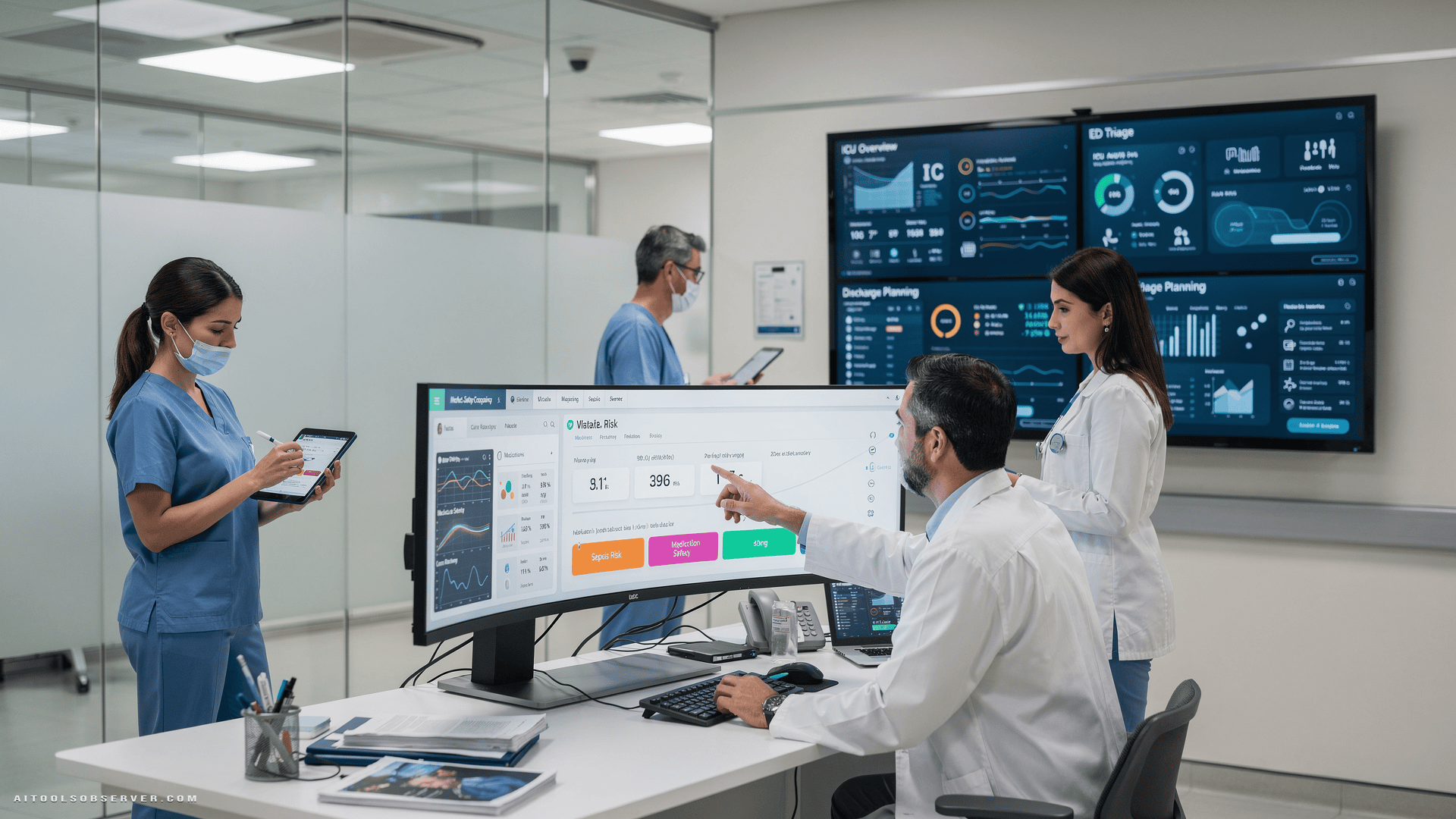
The Core Problem AI Is Solving in Healthcare
Healthcare workers spend an enormous amount of time on tasks that don’t directly involve patients. Scheduling, documentation, billing, prior authorizations — these administrative burdens consume hours that should go toward care.
At the same time, clinical teams are drowning in data. Lab results, imaging, patient histories, research literature — no human can synthesize all of it quickly enough to make the best decision every time.
AI addresses both problems simultaneously. That’s what makes it uniquely powerful in this sector.
Medical Documentation and Clinical Notes
One of the highest-impact use cases in 2026 is ambient AI documentation. Tools like Nuance DAX, Suki AI, and Abridge listen to patient-clinician conversations and generate structured clinical notes automatically.
Physicians report saving one to two hours per day. That’s not a small efficiency gain — that’s reclaimed time for patient care, research, or simply avoiding burnout.
Scheduling and Patient Flow
AI-powered scheduling tools analyze historical appointment data, no-show rates, and patient preferences to optimize clinic capacity. The result is fewer gaps, shorter wait times, and better resource allocation — without adding administrative staff.
What Clinical Decision Support Actually Means
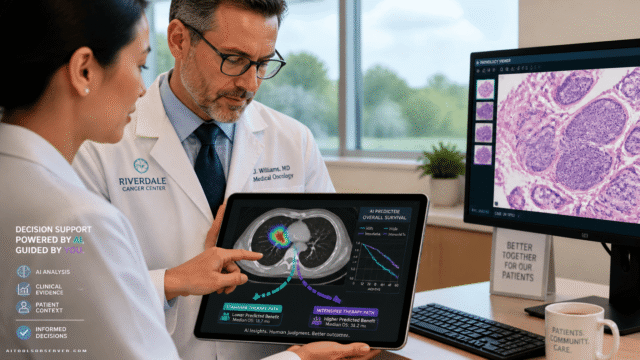
Clinical decision support (CDS) isn’t about replacing doctors. It’s about giving them better information at the right moment — a real-time second opinion backed by millions of data points.
In 2026, AI-powered CDS tools are embedded directly into electronic health records (EHRs), surfacing relevant alerts, drug interaction warnings, diagnostic suggestions, and treatment pathways as clinicians work.
Diagnostic AI: Reading What Humans Might Miss
Radiology and pathology have seen the most dramatic AI adoption. Tools like Aidoc, Viz.ai, and PathAI analyze medical images with accuracy that matches — and in some cases exceeds — experienced specialists.
These systems don’t replace radiologists. They prioritize the most urgent cases, reduce read times, and catch anomalies that might be overlooked in a high-volume environment.
Predictive Analytics and Early Warning Systems
Hospitals are deploying AI models that continuously monitor patient vitals and EHR data to predict deterioration before it becomes a crisis. Sepsis prediction, readmission risk, and ICU deterioration alerts are now standard features in leading health systems.
Epic’s Deterioration Index and Philips Early Warning Scoring are two examples of tools already embedded in clinical workflows at scale.
Population Health Management
AI is enabling health systems to move from reactive to proactive care. By analyzing population-level data, AI tools identify high-risk patient cohorts, recommend preventive interventions, and help allocate resources before problems escalate.
This is especially powerful for chronic disease management — diabetes, hypertension, heart disease — where early intervention dramatically changes outcomes.
Real-World Evidence and Research Acceleration
AI is compressing the timeline from data to insight in medical research. Natural language processing (NLP) tools can scan thousands of clinical notes, research papers, and trial results in minutes — surfacing patterns that would take human researchers months to identify.
Platforms like Mendel.ai and TriNetX are making real-world evidence more accessible to researchers and health systems alike.
The Tools Driving Healthtech Innovation in 2026
You don’t need to be a health system to benefit from these tools. Here’s a quick breakdown of where the most impactful AI tools are operating:
Administrative Automation
- Nuance DAX — ambient clinical documentation
- Cohere Health — prior authorization automation
- Suki AI — voice-powered clinical notes
Clinical Decision Support
- Aidoc — AI-powered radiology triage
- Viz.ai — stroke and cardiovascular detection
- Epic CDS — embedded EHR decision support
Health Analytics and Research
- PathAI — pathology image analysis
- TriNetX — real-world evidence network
- Mendel.ai — clinical NLP and data extraction
Each of these tools solves a specific, high-stakes problem. That’s the pattern worth noting — the best healthtech AI is narrow, focused, and deeply integrated into existing workflows.
Trust, Liability, and Explainability
Clinicians need to understand why an AI made a recommendation — not just what it recommended. Black-box models create liability concerns and erode trust. The push for explainable AI (XAI) in clinical settings is now a regulatory and ethical priority.
Data Quality and Interoperability
AI is only as good as the data it learns from. Healthcare data is notoriously fragmented — siloed across EHR systems, labs, imaging platforms, and payers. Solving interoperability is still one of the biggest barriers to scaling AI effectively.
Equity and Bias
AI models trained on non-representative datasets can perpetuate or amplify health disparities. This is an active area of concern among researchers and regulators. Any serious AI adoption strategy in healthcare must include bias auditing and diverse training data as non-negotiables.
How to Apply This as a Healthcare Operator or Builder
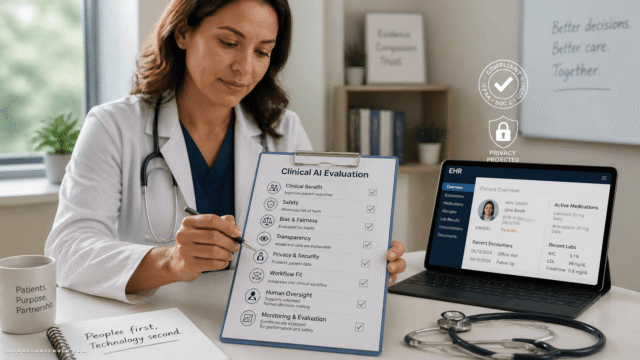
If you’re evaluating AI tools for a healthcare organization, here’s a practical framework:
Start with the highest-friction workflows. Where are your clinicians losing the most time? Where do errors most commonly occur? That’s where AI delivers the fastest ROI.
Prioritize integration over features. A tool that works inside your existing EHR is worth more than a standalone platform with better specs. Adoption depends on workflow fit.
Demand transparency. Ask vendors how their models were trained, what populations the data represents, and how the system explains its outputs. If they can’t answer clearly, that’s a red flag.
Measure outcomes, not just efficiency. Track clinical outcomes, not just time saved. The goal is better care — efficiency is a means, not the end.
The Bigger Picture
AI in healthcare isn’t a future promise anymore. It’s a present reality — already embedded in the tools clinicians use daily, already reshaping how health systems manage populations, and already accelerating the research that will define medicine in the next decade.
The organizations that will lead aren’t the ones waiting for perfect AI. They’re the ones learning to use imperfect AI thoughtfully — with clear governance, strong data practices, and a relentless focus on patient outcomes.
The tools are here. The question now is whether the people using them are asking the right questions.









Comments (0) No comments yet
Want to join this discussion? Login or Register.
No comments yet. Be the first to share your thoughts!