


What Is the Microduck?
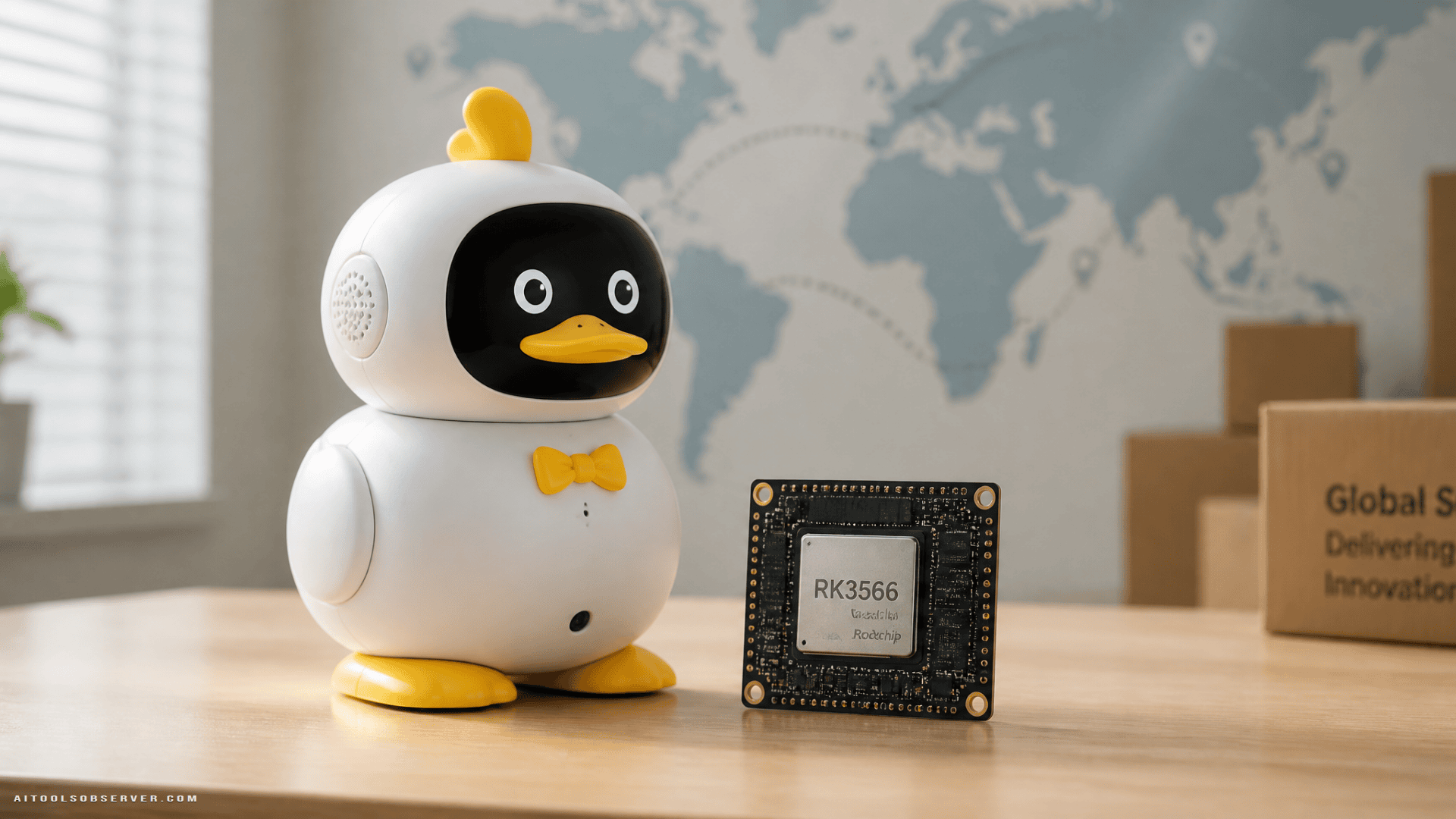
Microduck is a duck-shaped, 1.76-pound (800g) programmable robot designed to sit at the intersection of interactive toy and developer platform. It ships with pre-installed actions and runs on open-source software that allows it to learn from virtual simulations and goal-driven instructions.
It’s the second robot from Pollen Robotics, which Hugging Face acquired last year. The first robot from the same team also crossed 10,000 units sold — so this isn’t a fluke. There’s a repeatable audience here.
The Chip Inside: Rockchip RK3566
Here’s where the story gets more interesting than the cute duck exterior suggests.
The Microduck runs on Rockchip’s RK3566, a processor made by a Shanghai-listed Chinese semiconductor company. That chip uses technology licensed from British firm ARM — a detail that neatly illustrates how tangled global tech supply chains remain, even for a small consumer robot built by a French-American AI company.
Rockchip is described by Omdia chief analyst Lian Jye Su as a “key vendor” for edge AI — meaning AI that runs on the device itself rather than in the cloud. The company’s chips are commonly used for machine vision tasks like object detection and image recognition.
However, Su also noted a real limitation: Rockchip’s chips “are not designed for complex edge AI devices as they lack the compute resources.” That’s a meaningful constraint if you’re hoping Microduck will run heavy generative AI workloads locally.
For what Microduck is — a consumer robot with simulation-based learning and pre-installed behaviors — the RK3566 appears to be a practical fit. But it’s worth understanding the ceiling.
Why the Supply Chain Angle Matters
Hugging Face co-founder Thomas Wolf noted publicly that people were already monitoring the supply chain as orders surged. That’s not just a logistics footnote.
It reflects a broader reality: as consumer AI hardware scales, the dependency on specific chip suppliers — particularly those navigating complex geopolitical and trade environments — becomes a strategic variable. Rockchip reported a 40% year-on-year increase in operating revenue in the first half of the year, with net profit excluding one-time items surging more than 60%. The company is growing fast, and demand from products like Microduck is part of that story.
The Bigger Consumer Robotics Picture
Microduck isn’t launching into a vacuum. The consumer robotics space is heating up across price points and form factors.
- Zeroth launched a child-sized humanoid robot in China for 8,888 yuan this summer, with similar virtual simulation learning claims and plans to open-source its robotics system.
- Mondo Robotics raised more than 80 times its $50,000 Kickstarter goal for a Wall-E-style camera robot, with early bird pricing starting at $549.
These aren’t enterprise deployments or research lab projects. These are consumer products with real pre-order numbers, which signals that the market for personal robots is moving from novelty to category.
The Nvidia Acquisition Rumor
Just before Microduck launched, The Information reported that Nvidia had agreed to acquire Hugging Face for $12.9 billion. Neither company responded to requests for comment at the time of reporting.
If that deal materializes, it would place Microduck — and Pollen Robotics — inside one of the most powerful AI hardware ecosystems on the planet. That context makes the Rockchip chip choice, and the open-source robotics strategy, even more worth watching.
What This Means for AI Tool Observers
The Microduck story isn’t just about a robot that looks like a duck. It’s a useful data point on several fronts:
- Consumer demand for on-device AI hardware is real and growing. 10,000+ units in days is not a niche signal.
- Edge AI has chip constraints that matter. The RK3566 is capable for basic tasks, but complex generative AI on-device requires more compute than current affordable chips provide.
- Open-source robotics is a viable go-to-market strategy. Hugging Face’s approach — open software, accessible hardware, developer-friendly platform — is generating both sales and community momentum.
- Global supply chains are still deeply interconnected. A French-American AI company, a Chinese chip, British semiconductor IP. That’s the reality of building AI hardware at scale today.
If you’re tracking where AI tools and hardware intersect, consumer robotics is no longer a category to watch from a distance. It’s arriving — one duck at a time.









Comments (0) No comments yet
Want to join this discussion? Login or Register.
No comments yet. Be the first to share your thoughts!