



The Problem: Parkinson’s Doesn’t Negotiate
Parkinson’s is progressive. There’s no pausing it while you finish an album.
Smith, 49, watched his guitar skills deteriorate over the more than a year he spent working on The Art of Letting Go. The disease attacked the very thing he needed most: fine motor control in his hands.
He faced a stark choice. Stop creating. Or find a route around the limitation.
“Don’t play, don’t be creative, or find a way out, find a route,” Smith said. “And for me, this was the route.”
That route ran directly through AI music generation tools.
The Tools: Suno and Udio

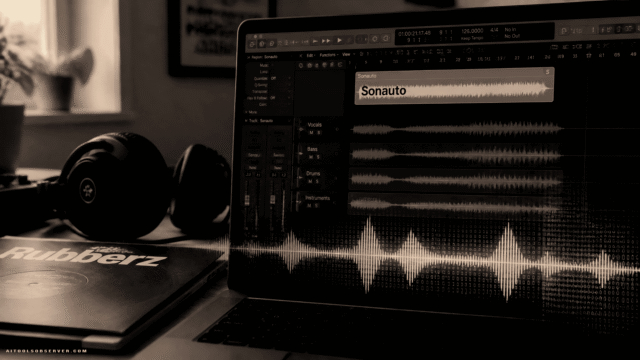
Both Suno and Udio are generative AI music platforms trained on large datasets of recorded audio. They analyze patterns in melody, harmony, and rhythm, then generate new audio from prompts or uploaded recordings.
You don’t need to play an instrument to use them. You don’t even need to sing well. You need a clear idea of what you want — and the patience to iterate.
For Smith, that last part turned out to be significant.
How He Actually Used Them

Smith’s workflow was straightforward in concept, demanding in execution.
- He hummed rough melodies into his phone.
- He uploaded those recordings into Suno or Udio.
- He added text prompts describing instrumentation, mood, and style.
- He edited the generated output extensively.
- He repeated the process — sometimes 50, 100, or 150 times per track.
The goal was never to use the AI output in the final recording. Smith was clear about that. The demos existed to communicate his vision to the session musicians who would actually record the songs.
“I upload my lyrics; AI doesn’t create my lyrics,” he said. “I upload my music; AI does not create my music. It then brings it to life in a way that I can play to session players and say, ‘Here, that’s what I’m thinking, that is what I’m hearing.’”
That distinction matters. Smith used AI as a translation layer between his creative mind and the musicians in the room.
The Setup: From Hum to Demo

The process sounds simple. In practice, it required real craft.
Getting a demo that sounded close to his Americana aesthetic — and close enough to communicate his intent to Grammy-winning musicians — meant hundreds of generation attempts and hours of editing. The AI outputs weren’t immediately usable. They needed to be shaped, filtered, and refined.
Smith’s prompts had to be specific. Instrumentation choices, mood descriptors, stylistic references — all of it fed into the generation process. Vague prompts produced generic results. Precise prompts, combined with his hummed melody as a reference, got closer to what he heard in his head.
This is a workflow that rewards musical knowledge. Smith’s decades of experience as a songwriter meant he knew exactly what he was listening for. Someone without that background would likely struggle to evaluate and iterate effectively.
The Results: A Real Album With Real Musicians

The Art of Letting Go is not an AI album. It’s a human album made possible in part by AI.
The project was produced by Grammy-winning pianist and producer Matt Rollings. The session musicians included dobro player Jerry Douglas (16-time Grammy winner), banjo player Alison Brown, fiddler Stuart Duncan, guitarist Bryan Sutton, bassist Viktor Krauss, and vocalists Jonatha Brooke and Glen Phillips. Grammy-nominated guitarist Julian Lage performed on the title track and on the instrumental piece “Horizon.”
Those are not names you associate with compromise.
Smith used AI-generated demos to communicate his vision to this ensemble. The demos served as a bridge — translating what he heard internally into something tangible that world-class musicians could respond to and build from.
The Moment That Defined the Album

“Horizon” became the album’s most emotionally loaded track.
Smith had used Suno and Udio to develop demo arrangements for the instrumental piece. But in the studio, something unexpected happened. After months of being unable to play, his arm freed up for roughly ten minutes.
He played a guitar duet with Julian Lage.
“I hadn’t been able to play for months, but I kept telling myself that if I wrote something to take to the studio, perhaps the clouds would part for a few minutes,” Smith said. “That’s what happened. I had a window of about 10 minutes in the studio when my arm freed up. So in the end, I was able to capture the last breath of my guitar playing.”
The AI demos made that moment possible. Without them, the song might never have reached the studio in a form that could be recorded.
Limitations: What AI Couldn’t Do
Smith’s workflow worked because of what he brought to it — not because of what the tools did automatically.
Iteration Fatigue Is Real
Generating 150 versions of a demo to find one that works is not a frictionless process. It requires time, focus, and the musical ear to evaluate each output critically. For someone managing a progressive neurological condition, that cognitive and emotional load is significant.
AI Output Needed Heavy Editing
The raw outputs from Suno and Udio weren’t usable as-is. Smith described extensive editing to get results that sounded close to his music. The tools accelerated a process — they didn’t complete it.
The Copyright Landscape Is Unsettled
Suno and Udio are operating in contested legal territory. Sony Music Entertainment, Universal Music Group, and Warner Records sued both platforms in June 2024 over alleged copyright infringement related to training data. Universal later settled and partnered with Udio; Warner did the same with Suno. But the broader debate about how these models were trained — and whose music contributed to them — remains unresolved.
A group of artists including Tift Merritt and David Lowery published an open letter in February 2026 under the heading “Say No to Suno,” warning about AI-generated works diluting royalties and enabling fraud. Their concerns are legitimate and worth weighing.
Overreliance Carries Its Own Risk
Ruaidhri Mannion, a composer and music producer who teaches at Brunel University of London, offered a useful counterpoint. The trial and error, frustration, and collaborative friction that define musical development are not bugs — they’re features. AI tools that smooth over that process too completely could interfere with artistic growth.
“What makes a lot of music-making meaningful is the collaborative element,” Mannion said. “There’s a lot of experimentation and development and failure that’s part of musical discovery.”
Smith’s use case avoided this trap because he brought decades of musical experience to the process. Someone earlier in their creative development might not.
The Broader Opportunity: Accessibility at Scale

Smith’s story points toward something the music industry hasn’t fully reckoned with yet.
Mannion noted that affordable digital recording software democratized music production over the past few decades. AI music generators could do the same for a different group — people whose physical limitations prevent them from playing instruments or communicating musical ideas through traditional means.
“If these tools are able to enable people to be able to participate with other creative groups and encourage more people to feel confident to be able to reach out to an ensemble or an orchestra or something, then I think that is all for the better,” Mannion said.
Smith has already started pushing in that direction. On May 21, 2026, he collaborated with the Berklee Music and Health Institute for an event in New York bringing together music industry leaders, researchers, and clinicians to examine how music supports people living with neurological conditions.
His message to the companies behind these tools was direct: “If these companies want to show they’ve got a place, a role in society, then step up. Engage with health professionals, engage with music therapists, engage with society and show us what you can do.”
Who Should Pay Attention to This Workflow

This case study is relevant beyond musicians with disabilities.
For musicians with physical limitations: Suno and Udio offer a real path to continued creative output. The workflow requires patience and musical judgment, but it works.
For producers and collaborators: AI-generated demos can function as a communication tool — a way to convey intent before expensive studio time begins.
For music therapists and health professionals: The therapeutic and creative potential of these tools for people with neurological conditions deserves structured research and clinical attention.
For AI tool builders: Smith’s use case is a proof of concept for responsible deployment. Accessibility applications are an underexplored and genuinely valuable direction.
Final Recommendation
Suno and Udio are not replacements for musical skill or creative vision. In Smith’s hands, they were amplifiers — tools that extended what he could do rather than substituting for what he could no longer do.
That’s the right frame for evaluating any AI tool in a creative workflow.
If you’re a musician managing a physical limitation, these platforms are worth serious exploration. Expect a steep iteration curve. Bring your own musical judgment to the process. Use the outputs as communication tools, not finished products.
If you’re evaluating AI music tools for accessibility applications more broadly, Smith’s workflow is one of the clearest real-world examples available of what responsible, human-centered use actually looks like.
Samuel Smith didn’t let Parkinson’s define his music. He found a route around it — and in doing so, made one of the more compelling arguments for what AI tools can actually be for.
“I’ve been able to pull this into something and refuse to be defined by this disease,” he said.
That’s not a story about artificial intelligence. It’s a story about creative persistence. AI just happened to be the tool that made it possible.









Comments (0) No comments yet
Want to join this discussion? Login or Register.
No comments yet. Be the first to share your thoughts!