



The Strategic Logic: Pixel as AI Proving Ground
Google has consistently used its Pixel line as a live testbed for AI capabilities before broader Android rollout. Android 17 makes that strategy explicit. Each new model integration targets a different user behavior — video editing, music creation, real-time translation — and each is tied to specific hardware tiers.
This is not feature bloat. It is a structured capability ladder designed to differentiate Pixel devices from the Android commodity market while simultaneously benchmarking Google’s model portfolio against real-world use cases.
Gemini Omni: Multimodal Editing Enters the Conversation

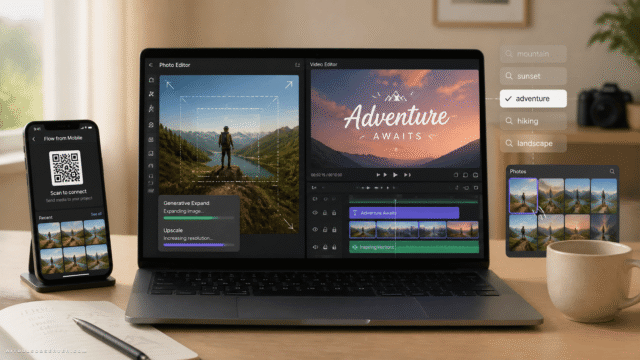
The most significant AI addition for general users is Gemini Omni‘s expanded role in video editing. Users can now edit videos directly within a Gemini conversation — trimming, adjusting, and refining footage through natural language dialogue rather than navigating a traditional editing interface.
This matters because it collapses the distance between intent and execution. The user describes what they want; the model interprets and applies it. For content creators working on mobile, this represents a meaningful reduction in friction.
Gemini Omni’s multimodal architecture — handling text, image, audio, and video within a single model context — is what makes this interaction pattern possible. It is a practical demonstration of why multimodal models are increasingly the baseline expectation rather than a premium feature.
Lyria 3: Text-to-Music Moves to the Consumer Layer

Lyria 3, Google’s music generation model, is now accessible directly within the Gemini app on Pixel. Users can generate music tracks using text prompts, images, or a combination of both.
Why This Placement Matters
Embedding Lyria 3 inside Gemini rather than a standalone creative app is a calculated distribution decision. It positions music generation as a natural extension of the assistant workflow rather than a niche tool requiring deliberate navigation.
For the AI tools ecosystem, this signals a broader pattern: generative media models are migrating from developer APIs and standalone platforms into ambient, conversational interfaces. The barrier to first use drops significantly when the capability lives inside a tool people already open daily.
AudioLM: Speech-to-Speech Translation on Pixel 10a
The Pixel 10a receives a targeted upgrade through AudioLM, Google’s speech model, which powers improved speech-to-speech translation directly on the device. This is on-device inference applied to a genuinely demanding task — real-time spoken language translation without routing audio through the cloud.
The On-Device Inference Argument
On-device AI for speech translation addresses two persistent user concerns: latency and privacy. Processing audio locally eliminates round-trip delays and keeps sensitive spoken content off remote servers. For a mid-range device like the Pixel 10a, shipping this capability sets a new expectation for what affordable hardware should deliver.
It also reinforces a competitive pressure point. As on-device model performance improves, the value proposition of cloud-dependent AI assistants weakens for latency-sensitive tasks.
Wear OS 7: AI Moves to the Wrist
Wear OS 7 is not a passive companion to Android 17. The update introduces emergency detection on the Pixel Watch — crash detection, fall detection, and pulse monitoring — with automatic alerts to emergency services and designated contacts. This is AI applied to safety-critical infrastructure, not productivity.
Personal Intelligence and the Connected Ecosystem
Looking ahead to summer, Wear OS will gain Gemini-powered Personal Intelligence features that connect Google apps and chat history to the watch experience. Users will be able to generate personalized widgets by describing them in natural language.
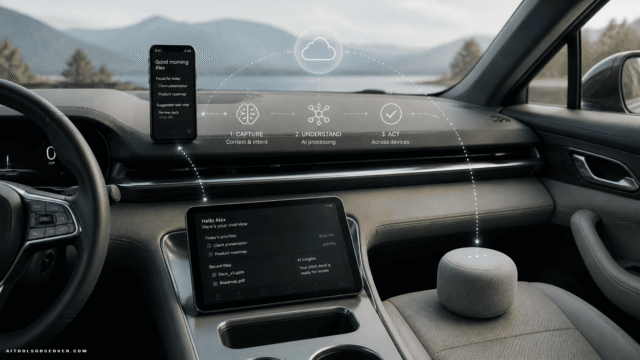
This is a meaningful architectural shift. The watch stops being a notification mirror and begins functioning as a context-aware interface that understands the user’s broader digital environment. Combined with announced compatibility with Google’s upcoming AI glasses and audio hardware, Wear OS 7 is positioning itself as a node in a larger ambient computing stack.
Battery improvements of up to 10% and multistep automation round out the wearable update — practical gains that make the AI features more usable in daily conditions.
Beyond AI: The Platform Features Worth Noting
Android 17 ships several non-AI features that reflect genuine UX thinking.
The bubble bar introduces a persistent, movable interface layer at the bottom of the screen for rapid app switching — a meaningful improvement for multi-app workflows on larger displays and foldables. A dedicated foldable gaming mode offers a 50/50 split layout with a dynamic gamepad, acknowledging that foldable form factors need purpose-built interaction patterns.
The simultaneous selfie and screen recording feature targets social media creators directly, enabling reaction video formats compatible with TikTok, YouTube, and Instagram without third-party tools.
Parental controls received a structural improvement: screen time limits and content filters can now be configured with a PIN without requiring a linked Google account. This reduces friction for families and addresses a legitimate privacy concern in the existing setup flow.
Quick Share gaining AirDrop compatibility on Pixel 8a and 9a devices is a quiet but practical interoperability win, particularly for mixed-device households.
What This Release Signals for the AI Tools Ecosystem
Android 17 is a useful benchmark for anyone tracking where AI capability is consolidating. Several patterns are worth registering.
Generative AI is becoming ambient. Lyria 3 and Gemini Omni are not apps users launch with intent — they are capabilities embedded inside existing workflows. The implication for standalone AI tools is clear: distribution inside high-frequency surfaces increasingly outweighs feature depth in isolation.
On-device inference is the competitive frontier. AudioLM on Pixel 10a and emergency detection on Pixel Watch both demonstrate that capable AI no longer requires cloud connectivity. Tool builders and platform evaluators should treat on-device performance as a primary benchmark, not a secondary consideration.
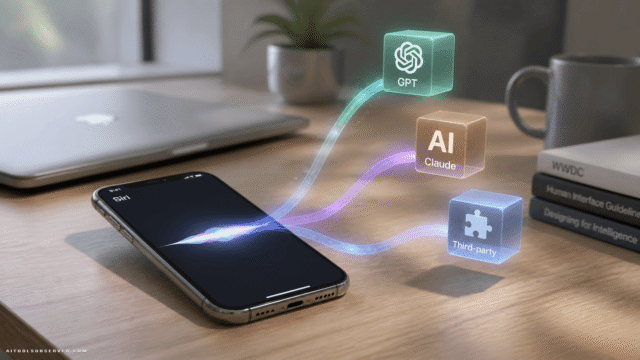
The assistant is becoming the interface. Editing video through conversation, generating widgets by description, translating speech in real time — these interactions share a common architecture. The model is the UI. Traditional interface layers are being compressed or removed entirely.
Closing Observation
Google’s Android 17 release is not a feature list. It is a position statement about where AI capability belongs — embedded in the device, accessible through conversation, and distributed across every surface from phone to watch to glasses.
For founders building AI tools, marketers evaluating platforms, and adopters choosing their next workflow stack, the practical takeaway is straightforward: the gap between AI as a discrete tool and AI as an integrated layer is closing faster than most roadmaps anticipated. Observing how Google structures that integration on Pixel is one of the cleaner ways to read where the rest of the market is heading.








Comments (0) No comments yet
Want to join this discussion? Login or Register.
No comments yet. Be the first to share your thoughts!